Error reduction below the threshold
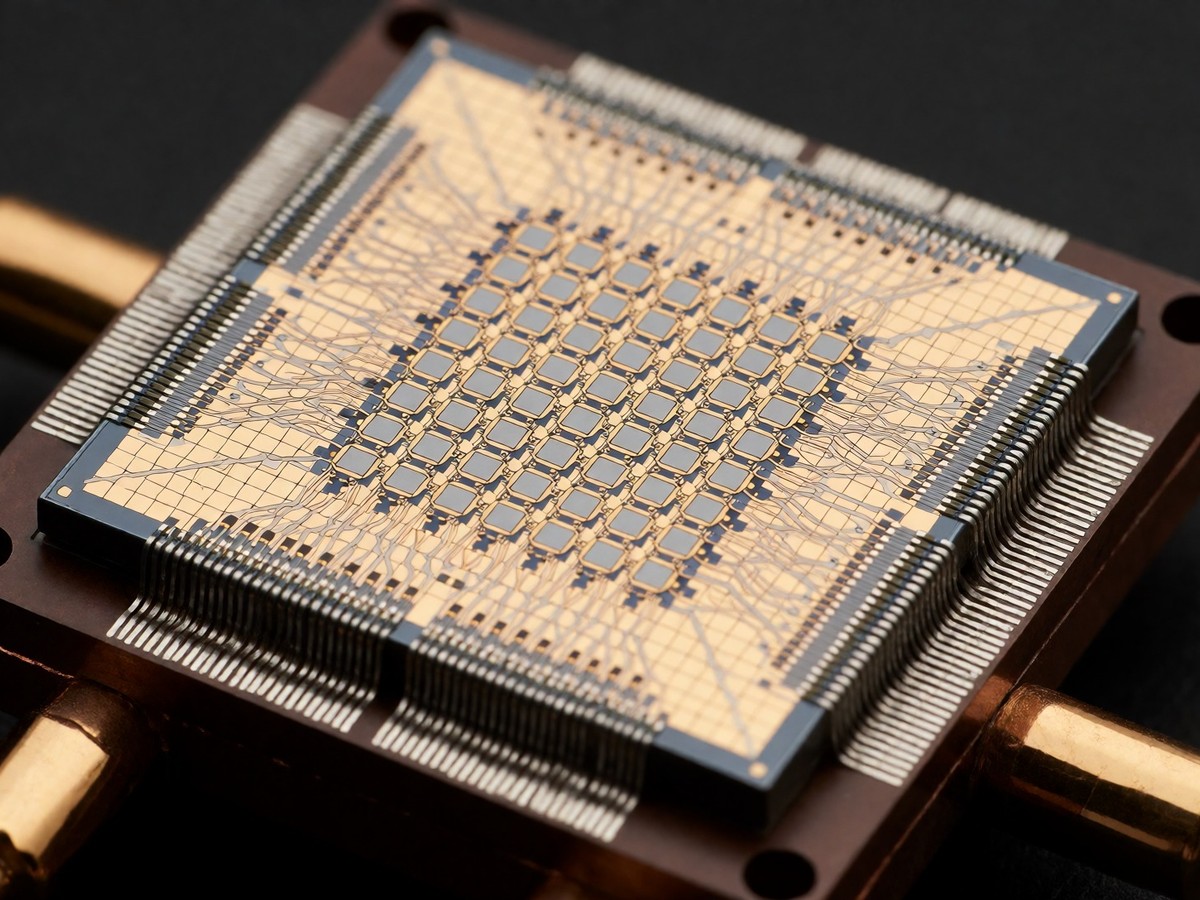
Google’s Willow chip completes a Random Circuit Sampling calculation in under five minutes. The Frontier supercomputer would require 10 septillion years to perform this task. Hartmut Neven, the founder of Google Quantum AI, describes this timeframe as a one followed by 25 zeros. This achievement addresses a problem researchers faced for nearly 30 years. Google’s team of 300 people scaled physical qubit grids from 3×3 to 5×5 and 7×7 to prove that error rates drop as the system grows. The Willow chip is a convincing prototype for a scalable logical qubit. This chip contains 105 superconducting transmon qubits arranged in a square grid. It maintains error rates of 0.035% for single-qubit operations and 0.33% for two-qubit operations. The system performs 909,000 error correction cycles every second. The average T1 time for these qubits is approximately 68 microseconds. This performance is compared to the 2019 Sycamore chip, which completed a task in 200 seconds that would take a supercomputer 10,000 years. The Sycamore announcement faced criticism from researchers who called the claim of quantum supremacy indefensible. The Willow team uses surface codes to implement error correction. This method uses multiple physical qubits to redundantly encode one logical qubit. The Willow chip demonstrates that adding more physical qubits reduces error rates rather than increasing them, which is the first time scientists have achieved this level of scalability in a quantum system. Scientists cool these superconducting circuits to approximately 20 millikelvin to allow electrical current to flow without losing energy. Researchers manipulate the energy in the circuit by sending precisely timed microwave pulses.
AI workload optimization and power use
The Willow architecture integrates AI capabilities at the hardware level to handle tasks like natural language processing and image recognition. It uses tensor processing units to accelerate matrix computations used in training AI models. This design uses less power than conventional processors. You should observe how these hardware-level improvements target tasks like predictive analytics and autonomous decision-making. Google DeepMind and the Quantum AI team developed AlphaQubit, a machine learning decoding system, to find and fix errors. AlphaQubit performed better than human-designed methods for locating errors. One researcher noted that Random Circuit Sampling, the benchmark used for Willow, has no known real-world applications. This benchmark tests quantum state complexity rather than solving a practical problem. Other companies, including IBM and Honeywell, use a metric called quantum volume to measure machine capabilities by factoring in qubit interaction. Because Google does not mention quantum volume for Willow, comparing the two is difficult. Worldwide, private and public investment in quantum technology has totaled around $20 billion over the past five years. Both the United States and China invest heavily in this field. Washington also placed restrictions on the export of sensitive quantum technology. The Willow chip competes with hardware from NVIDIA, AMD, and Apple. While NVIDIA dominates with GPUs designed for AI, Willow focuses on AI specialization and integration within the Google ecosystem.
Physics and performance specs
The hardware could assist in modeling plasma stability for nuclear fusion or designing new batteries. These capabilities could lead to advances in drug discovery and materials science. Willow could assist in optimizing logistics problems like supply chain routing or improving cryptography. The chip supports self-driving technologies and robotics by processing sensor data in real-time. It also helps cloud computing and consumer electronics, including Pixel smartphones and Nest devices. Google manufactures the chip in Santa Barbara, California. The Willow chip has 99.97% fidelity for single-qubit gates, 99.88% for entangling gates, and 99.5% for readout.
| Specification | Value |
|---|---|
| Qubit count | 105 |
| Single-qubit fidelity | 99.97% |
| Entangling gate fidelity | 99.88% |
| Readout fidelity | 99.5% |
| Error correction cycles | 909,000 per second |
| T1 time | ~68 microseconds |
Will these error reduction capabilities work on even larger arrays of thousands of qubits?