Hyundai Motor Group owns 100% of Boston Dynamics after paying SoftBank $325 million for the remaining 20% stake. This purchase follows a December 2020 agreement where Hyundai acquired an 80% stake for $880 million, valuing the company at $1.1 billion. The robotics firm began in 1992 as a spinoff from the MIT Leg Lab under Marc Raibert and Robert Playter. Nancy Cornelius joined as the first employee and served as CFO for 10 years. The robotics company moved from an MIT spinoff in 1992 to Google in 2013, then to SoftBank in 2017, before Hyundai began its multi-stage acquisition to secure full control over the specialized hardware and software intellectual property. Early work involved the American Systems Corporation, where the team replaced naval training videos with 3D simulations using DI-Guy software. Later, DARPA funded BigDog, a quadruped designed to carry 340 pounds. The project ended because the robot was too loud for combat use. In 2010, the team developed the LS3, a version of BigDog that carried 400 pounds and marched 20 miles on a single charge.
From research labs to enterprise revenue
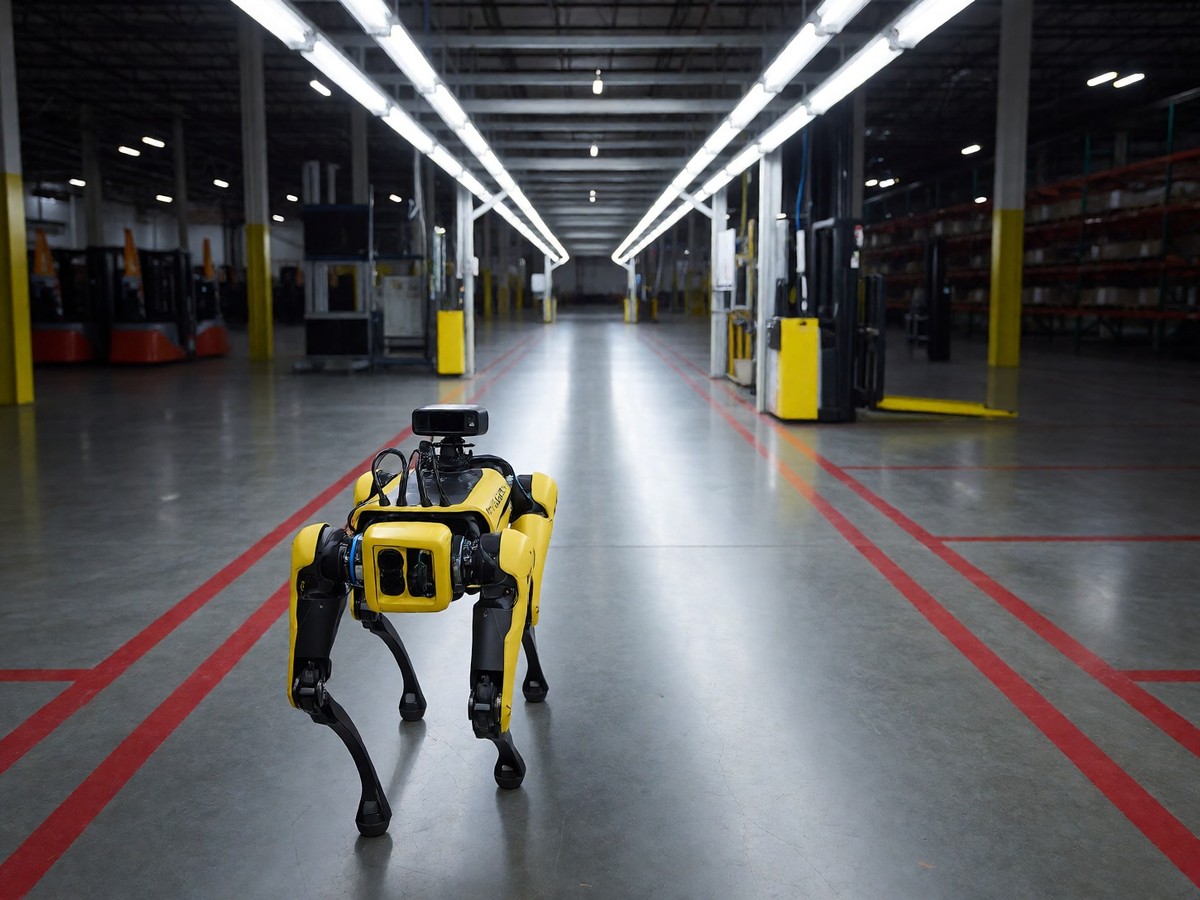
Boston Dynamics generates revenue through three distinct product lines: Spot, Stretch, and Atlas. Spot is the quadruped that performs inspection rounds for clients like BP, SpaceX, and National Grid. While older data listed a $74,500 price for Spot, public procurement records show configured units cost between $150,000 and $375,000. The Massachusetts State Police became the first law enforcement agency to use Spot in 2019. In 2020, Singapore deployed Spot for pandemic patrol in public parks. Stretch handles warehouse tasks like unloading trucks and moving cases for customers including DHL and GAP. The robot has a suction pad array to grab boxes weighing up to 23 kilograms. By January 2026, Boston Dynamics reported that combined deployments of Spot and Stretch exceeded 2,000 units.
| Robot | Primary Application | Deployment Status |
|---|---|---|
| Spot | Industrial Inspection | 1,500+ units deployed |
| Stretch | Warehouse Automation | Over 2,000 total units |
| Atlas | Manufacturing Tasks | 2026 production deployments |
The company shifted from research demos to practical tools when it retired the hydraulic Atlas in April 2024. The new all-electric Atlas has 28 joints and custom linear actuators. This version focuses on factory-floor tasks like lifting and placing boxes. You know the industry’s obsession with humanoid robots, but the electric Atlas targets reliable movement in manufacturing environments. The company faces competition from Figure AI, which raised $675 million in February 2024.
Humanoid competition and the factory floor
The competition for the humanoid market includes Tesla, Figure AI, and Agility Robotics. Hyundai plans to deploy Atlas in its Georgia facility this year to perform sequencing tasks. Tesla develops Optimus as an automated assistant, while Agility Robotics has already deployed the Digit humanoid in Amazon and GXO warehouses. Figure AI introduced the Figure 03 in October 2025, which has a 60% wider field of view and fingertip tactile sensors. Figure AI’s valuation reached $3.9 billion following a September 2025 funding round.
Hyundai’s investment in robotics includes a plan to build a U.S. facility with an annual capacity of 30,000 units. This move supports Hyundai’s broader $26 billion commitment to the United States. The company also invests in autonomous driving through partnerships with NVIDIA and Waymo. Robert Playter stepped down as CEO in February 2026, leaving Amanda McMaster as interim CEO. Boston Dynamics relies on its history of locomotion data to maintain an edge. While Figure AI attracts media attention, Boston Dynamics ships products that generate immediate revenue. The company faces a choice between high-cost specialized machines and the mass-market goals of companies like Tesla. Will the high cost of these enterprise systems prevent widespread adoption in smaller manufacturing plants?