Physical Intelligence discusses a new $1 billion funding round at a valuation exceeding $11 billion. This potential raise follows a $600 million Series B in November 2025 that reached a $5.6 billion valuation. Agility Robotics pursues a different economic strategy through a $2.5 billion merger with the SPAC Churchill Capital Corp XI. While Physical Intelligence focuses on the intelligence layer for any robot, Agility Robotics builds and deploys the physical machines. The robotics market is currently splitting into two distinct economic realities: the high-valuation promise of intelligence-only startups and the order-backed reality of hardware deployment companies.
The rapid capital climb of Physical Intelligence
Physical Intelligence is a San Francisco robotics startup founded in late 2023. The founding team includes Karol Hausman, Sergey Levine, Chelsea Finn, and Brian Ichter. They also include Lachy Groom, Adnan Esmail, and Quan Vuong. Karol Hausman led Google Brain’s robotics moonshot program. Sergey Levine built the RAIL Lab at UC Berkeley. Chelsea Finn runs the Stanford IRIS Lab. The company raised $400 million in a Series A in November 2024. This round included Jeff Bezos, Thrive Capital, Lux Capital, and Bond. CapitalG, the independent growth fund from Alphabet, led the $600 million Series B in November 2025. Investors like T. Rowe Price and Index Ventures also joined the Series B. Physical Intelligence is now in discussions to raise about $1 billion at a valuation exceeding $11 billion. This target represents a doubling of its $5.6 billion valuation from just four months ago. The company employs around 80 people. It has yet to deploy its software beyond testing environments. This lack of a commercialization timeline makes the $11 billion valuation a bet on unproven research.
Foundation models and the $\pi$-series
Physical Intelligence develops the $\pi$-series foundation models. The $\pi0$ model arrived in October 2024 and handles tasks such as laundry folding and grocery bagging. $\pi0.5$ released in April 2025 and added open-world generalization. This model can interpret high-level commands like "clean the bedroom" and break them into subtasks. The $\pi0.6$ model with RECAP arrived in November 2025 and enables self-improving robots. These models learn from their own deployment experience. The $\pi0.6$ model achieves a 130% throughput improvement on production tasks. Physical Intelligence open-sourced $\pi0$ to make its architecture a standard for the industry. The company provides model weights, fine-tuning tools, and inference code. This strategy aims to control the ecosystem similarly to how large language models dominate digital tasks. The company targets a business model of model licensing and API access. Manufacturers would pay for these models as a plug-and-play brain for their hardware.
The physical reality of Agility Robotics
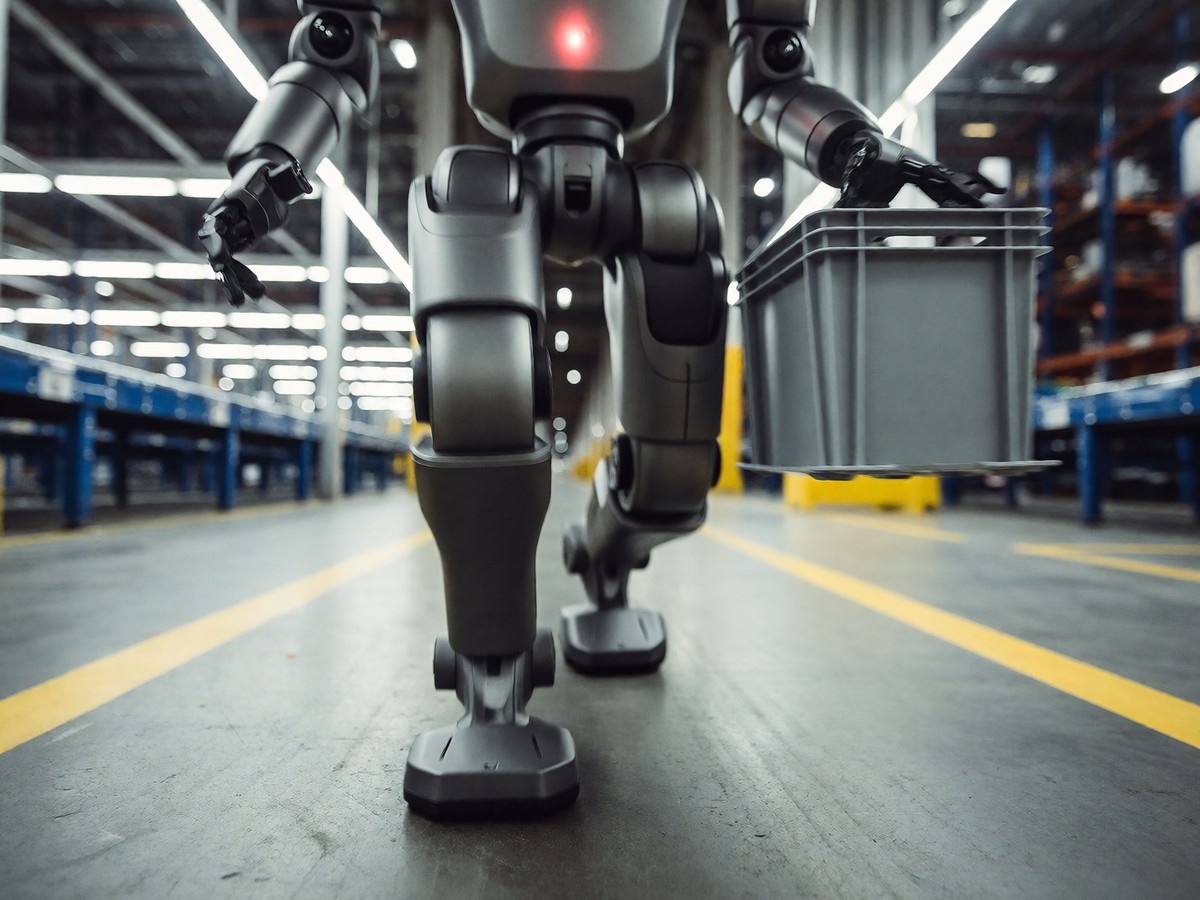
Agility Robotics builds the Digit robot for industrial work. The company is set to become the first publicly traded U.S. company dedicated solely to humanoid robots through its merger with Churchill Capital Corp XI. This merger values Agility at $2.5 billion. The company has more than $300 million in multi-year orders for the Digit 5. These orders depend on the company meeting certain contractual milestones. Agility’s Digit 5 is designed for cooperatively safe work. It works in close proximity to people without the physical safety barriers that traditional automation requires.
| Feature | Digit 5 Specification |
|---|---|
| Payload Capacity | 50 lb. (22.7 kg) |
| Battery Runtime | 90 minutes |
| Charge Ratio | 10:1 |
| Total Weight | 284 lb. (129 kg) |
| Reach Height | 7.2 feet (2.2 m) |
Agility’s Digit 5 uses proprietary AI algorithms to monitor for people. The robot can autonomously avoid people, stop, or assume a seated position. Visual and auditory cues alert nearby people to motion intent. An independent safety controller oversees the response to people within unsafe distances. Agility is the first launch partner for NVIDIA’s Halos for Robotics platform. This partnership pairs Agility’s systems with NVIDIA IGX Thor and Halos Core infrastructure.
Deployment scale and operational data
Agility Robotics has over 65,000 hours of real-world operation. The company uses its robots at sites for GXO, Schaeffler, Amazon, and Toyota Motor Manufacturing Canada. At the GXO facility in Georgia, Digit 4 reached a 100,000-tote milestone. It maintained 98% accuracy while on-task. Agility manages its fleets through the Agility Arc cloud platform. This platform provides visibility into uptime, throughput, and Mean Time Between Incidents. The company builds robots at its RoboFab facility in Salem, Oregon. This facility can produce 10,000 robots annually and employs more than 500 people. Agility’s new Fremont, California facility serves as a hardware and physical AI development hub. You likely know the difference between a research lab and a factory floor. Agility focuses on the latter.
The economics of humanoid production
The cost to build a humanoid robot varies by volume and supply chain. BofA Global Research estimates that a humanoid built on Chinese supply chains carried a bill of materials of $35,000 in 2025. Western development still costs $90,000 to $100,000 per unit. Actuators account for more than half of the projected 2030 bill of materials for a humanoid. A full-size robot requires 28 to 44 actuators. High-torque actuators for hip and knee joints cost between $500 and $2,000 each at low volumes. Tesla aims to produce 1 million Optimus robots annually to lower these costs. If Tesla reaches this scale, actuator costs could drop to $100 to $300 each. This would save $15,000 to $25,000 per robot. Chinese companies like Unitree price models aggressively. The Unitree G1 costs $13,500, while the R1 costs $5,900. The Unitree H2 costs $29,900.
Analyzing automation ROI in the factory
Businesses calculate the return on investment by comparing robot costs to human labor. A humanoid robot priced at $50,000 with $15,000 in annual operating costs has a $65,000 total Year 1 cost. Over five years, the total cost of ownership reaches $125,000. An equivalent human worker working two shifts costs between $90,000 and $110,000 per year. Over five years, the human total cost of ownership reaches $600,000 to $700,000. A robot can pay for itself in 12 to 18 months.
In 24/7 manufacturing, the night shift creates information gaps. A 2025 industry survey found that 73% of unplanned downtime events during night shifts were first detected during the day shift handover. This delay costs mid-size facilities an average of $1,786 in lost production for every hour of delayed response. Manual report preparation for night shifts costs about $25,200 annually for three to four personnel. Diagnostic friction at the start of a shift consumes 117 hours of supervisor time annually, valued at $9,360.
Comparing business models and training
The robotics industry is splitting into two different models. Physical Intelligence targets the software layer. It builds models that work on any hardware. This company seeks to license its $\pi$-series to manufacturers like Figure AI and Agility Robotics. Agility Robotics targets the full stack. It uses a Robotics-as-a-Service model to remove upfront capital and technical risk. Agility’s contracts commit to moving a specific number of totes per hour with specific reliability.
Agility trains its robots using Learning from Demonstration. Engineers use VR headsets to teleop Digit. They use two controllers to show the robot how to perform tasks. This creates data for the middle layer of the intelligence stack. Agility also uses simulation training. The company uses NVIDIA Isaac Lab for reinforcement learning. This allows a virtual Digit to discover movements in simulation without risking hardware.
Will the intelligence-first approach of Physical Intelligence provide enough value to justify its massive valuation if hardware manufacturers continue to build their own proprietary AI stacks? The robotics market is currently splitting into two economic realities: the high-valuation promise of intelligence-only startups and the order-backed reality of hardware deployment companies. Physical Intelligence sells the brain. Agility Robotics sells the worker. The $11 billion valuation for a company with no commercial products shows the demand for physical AI. Agility’s $300 million in orders shows that customers prioritize reliability over research.