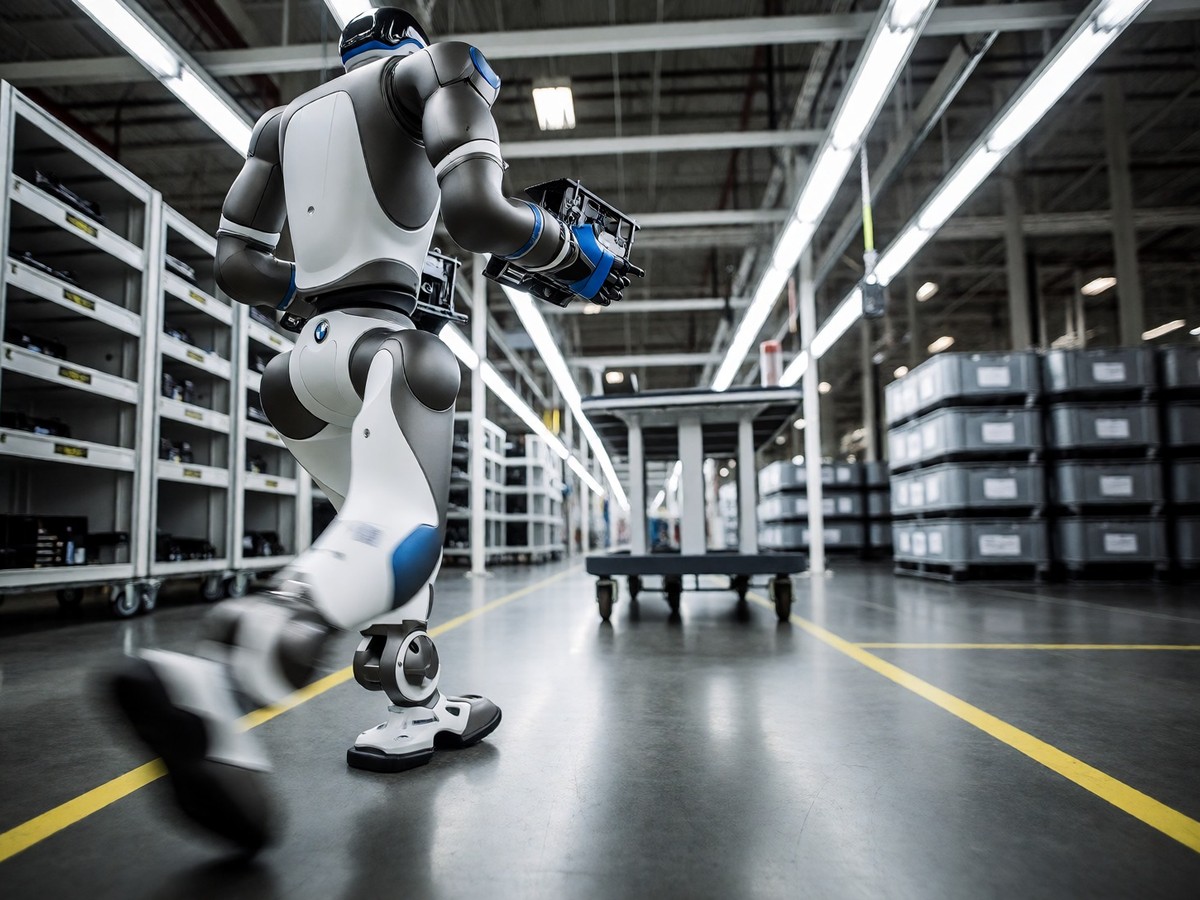
BMW Group installed Figure 03 robots in Hall 52 at its Spartanburg plant to manage logistics sequencing. These machines sort components from bulk containers into sequencing trolleys before delivery to assembly stations. This deployment follows the 2025 pilot where Figure 02 robots worked in the body shop for 10 months. During that period, the Figure 02 units moved 90,000 components and supported the production of 30,000 BMW X3 vehicles while logging 1,250 operating hours. I believe this deployment proves that humanoid robots can handle repetitive manufacturing tasks in live production environments. BMW plans to produce the electric iX5 in this facility before 2026 ends. The company also plans to build at least six fully electric models in the U.S. by 2030. This South Carolina plant remains the automaker’s only U.S. facility and its most productive factory worldwide. The $1.7 billion investment in the region supports the production of these electric vehicles. Jose Asumendi of JPMorgan attended the "Home of X" event at the plant, where he noted that the Spartanburg facility advances innovation through physical AI. He observed that the robots assist associates by taking on physically demanding and repetitive work. BMW separates its Spartanburg work from its Leipzig pilot, where it uses Hexagon’s AEON robot for high-voltage battery assembly. While Spartanburg focuses on logistics, Leipzig tests different tasks with different operating conditions.
Figure 03 uses the Helix AI system to process instructions and navigate the factory. The architecture uses System 2 for semantic reasoning, System 1 to produce full-body joint targets at 200 Hz, and System 0 to manage balance and contact at 1 kHz. System 2 uses an internet-pre-trained Vision Language Model to understand scenes and language. System 1 provides a fast visuomotor policy to translate those insights into immediate actions. I find the hardware changes in Figure 03 functional for the factory floor.
| Figure 03 Specification | Value |
|---|---|
| Height | 5 ft 8 in |
| Weight | 61 kg |
| Payload | 20 kg |
| Runtime | 5 hours |
| Speed | 1.2 m/s |
Figure 03 includes soft exterior components for safety and wireless charging for convenience. The company produced more than 350 units and moved from producing one robot per day toward one per hour as of April 2026. These robots work alongside humans to handle physically demanding tasks. Figure 02 previously demonstrated capabilities that were four times faster and seven times more accurate than its predecessor. The Figure 02 model has six RGB cameras, 50% more battery capacity than earlier models, and hands with 16 degrees of freedom. Its onboard NVIDIA RTX GPU modules triple the inference power compared to earlier models. The robot can lift 25 kilograms. The models learn from human movement and from simulation before real use. Does the rapid scaling of production match the actual demand from manufacturers?
The humanoid market shows heavy movement. AgiBot shipped 9,700 robots in the first half of 2026, which accounts for 43% of global shipments. Figure AI maintains a $39 billion valuation despite these lower shipment numbers. I find the massive disparity between AgiBot’s 9,700 unit shipment count in the first half of 2026 and Figure AI’s $39 billion valuation to be the most glaring and confusing inconsistency in the current global humanoid robotics market. Unitree reported group revenue exceeding RMB 1.70 billion in 2025. You should note that the market remains split between companies shipping research tools and those deploying industrial workers.
Tesla plans to start Optimus production before the end of 2026. 1X offers the NEO robot for $20,000 or a monthly subscription of $499. The NEO robot has a height of 5 ft 6 in, a weight of 66 lb, a four-hour runtime, and a 1.4 m/s walking speed. Agility Robotics delivers Digit fleets to customers like GXO and Amazon via a Robot-as-a-Service model. I would skip the 1X subscription if you need a machine for heavy warehouse lifting because Digit handles those tasks with better reliability. Agility’s Digit has a height of 5 ft 9 in, a weight of 140 lb, a 35 lb payload, and four hours of battery life. Agility’s June 2026 update named GXO, Schaeffler, Toyota Canada, and Mercado Libre as current customers. Boston Dynamics’ electric Atlas has a 50 kg instantaneous payload and a 30 kg sustained payload. I find the commercial status of most competitors to be a mess of pilots and unfulfilled production promises. Unitree offers the G1 starting at $13,500, while the smaller R1 starts at $5,900, and the H1 costs $90,000. Apptronik develops the Apollo 2 with partners including Mercedes-Benz and Google DeepMind.