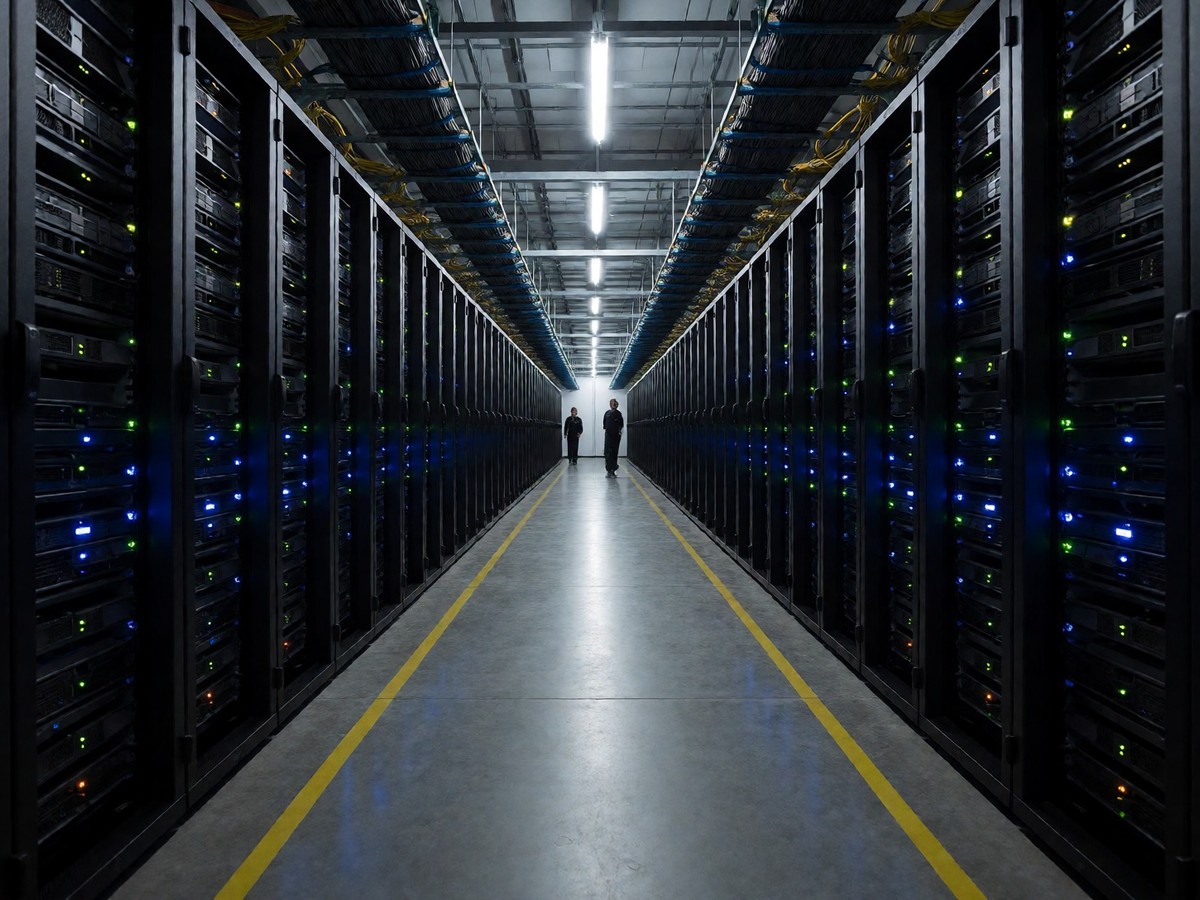
AI power demand grows 40% to 70% per year, but global electricity generation only expands 2% to 4% annually, creating a massive gap that no amount of capital can overcome. A single advanced AI datacenter for frontier-model training draws 600 to 1,000 megawatts of continuous power, an amount that equals the consumption of a mid-size city or a full nuclear reactor. I consider the idea of silicon as the primary bottleneck completely wrong. You can order 20,000 GPUs overnight, but you cannot order 20,000 megawatts of electricity. The infrastructure for transmission and power supply evolves in years, not quarters, because high-voltage transformers have 24 to 36 month lead times and essentially no surge capacity. The PJM Interconnection announced that it requires an additional \$23.1 billion investment across its operating area, which remains the largest in the United States, to address the growing electricity demand coming from several massive and energy-hungry data centers. The energy issue remains sensitive. Data center energy consumption draws comparisons to whole nations. Some argue that higher electricity prices in data center-heavy locations relate to the local energy mix, such as wind and solar, which can make bills higher in Europe. However, political opposition to AI developers rises across party lines. Politicians use legislative authority to make Big Tech pay for the electricity and transmission infrastructure needed to secure the power supply.
TPU vs GPU Pricing
I compare the pricing of Google’s TPU pods to the costs of NVIDIA hardware. Google’s TPU v5p in Columbus or South Carolina costs \$4.20 per chip-hour for on-demand users. A 1-year commitment for this capacity reduces the price to \$2.94 per hour, while a 3-year commitment brings the cost down to \$1.89 per chip-hour. For those using the Trillium (v6e) generation, on-demand costs sit at \$2.70 per chip-hour, dropping to \$1.89 with a 1-year commitment and \$1.22 with a 3-year commitment. The newer Ironwood (v7) hardware shows higher efficiency, and SemiAnalysis estimates Anthropic pays roughly \$1.60 per chip-hour through a negotiated deal. In the NVIDIA landscape, the B200 on Spheron costs \$11.12 per GPU per hour for on-demand access as of October 30, 2026, and \$5.25 per hour for spot access.
| Hardware | Type | On-Demand Rate (USD/hr) | 3-Year Commitment (USD/hr) |
|---|---|---|---|
| TPU v5p | Cloud TPU | \$4.20 | \$1.89 |
| Trillium (v6e) | Cloud TPU | \$2.70 | \$1.22 |
| TPU v5e | Cloud TPU | \$1.20 | \$0.54 |
| NVIDIA B200 | GPU | \$11.12 | N/A |
If I look at the performance per dollar for training dense LLMs like Llama2-70b and Llama3.1-405b, Trillium provides up to a 2.5x increase in performance per dollar over TPU v5p. The Ironwood generation provides a 10x peak performance jump over TPU v5p. For inference, Llama 70B FP8 on a B200 costs about \$2.60 per 1M tokens on-demand. To match that cost, an Ironwood chip needs to deliver roughly 171 tokens per second. Other options like the TPU v4 pod in Oklahoma cost \$3.22 per chip-hour on-demand or \$1.449 with a 3-year commitment.
Can Scaling Continue?
The massive capital expenditures for AI infrastructure create complex financial cycles. Anthropic’s deal for Ironwood involves an initial phase of 400,000 units, which equates to \$10 billion in finished racks, and a further commitment of 600,000 more units, worth \$42 billion in remaining performance obligations. This massive scale targets over a gigawatt of capacity for 2026. Meanwhile, Nvidia’s move to buy Hugging Face for \$12.93 billion shows a push into the developer ecosystem. Nvidia’s moves extend beyond Hugging Face; in December 2025, Nvidia agreed to pay \$20 billion for assets from Groq, a chip startup. This agreement involves licensing Groq’s technology and bringing over its people. A few months before that, in September 2025, Nvidia spent more than \$900 million to hire Enfabrica’s CEO and staff and license its technology. I believe the industry relies on circular financing to sustain these costs. OpenAI announced a \$110 billion investment round where Amazon provided \$50 billion, and in return, OpenAI agreed to expand an existing \$38 billion AWS deal by another \$100 billion over eight years. Google also competes through massive commitments, such as Anthropic’s commitment of up to \$40 billion to Google alongside gigawatts of its own TPU capacity. I would skip the expensive on-demand rates of NVIDIA if you already have a deep relationship with Google Cloud. The migration cost to JAX from a CUDA-based stack like vLLM remains real. Can these massive capital infusions continue if the energy grid cannot keep up? My verdict places the availability of electrons above the importance of hardware.