Physical Intelligence maintains a $5.6 billion valuation following a $600 million Series B in November 2025. The company entered talks in March 2026 for a $1 billion round that would push its valuation above $11 billion, which would nearly double its November figure in about four months. This software-centric approach targets the intelligence layer rather than the physical chassis. While Figure AI reaches a $39 billion valuation, Physical Intelligence focuses on the model that controls any robot body. The founding team includes Karol Hausman, Sergey Levine, Chelsea Finn, Brian Ichter, Lachy Groom, Adnan Esmail, and Quan Vuong. The company raised $1.1 billion in total across its first two years, including a $400 million Series A in 2024. Investors include OpenAI, Jeff Bezos, NVIDIA, CapitalG, Thrive Capital, and Lux Capital. Skild AI holds a $14 billion valuation after a $1.4 billion SoftBank-led round in January 2026. The model’s capabilities remain closer to GPT-1 than current state-of-the-art language models.
p0 Technical Capabilities and Model Evolution
The p0 model translates natural language instructions into continuous robot motor commands using a flow matching architecture. This method produces smoother, more natural robot motions than discrete token-based models. The 3.3 billion parameter system combines a 3-billion-parameter PaliGemma vision-language model with 300 million parameters for robot control. The model processes multi-view camera images and language instructions to output continuous action trajectories. The system trained on over 10,000 hours of real-world robot data across seven different robot platforms. It uses a dual-expert design where the VLM expert handles observations and the action expert manages motor generation. In tests, p0 autonomously picks up laundry from a dryer and folds it, showing resilience if humans intervene mid-task. The model also handles bussing tables by shaking off trash from plates before stacking them into a bin. In "bussing easy" tasks, the robot earns one point for each of the seven correctly sorted objects. In "bussing hard" evaluations, the robot correctly sorted 12 objects, including difficult items like a chopstick on top of trash. The company released p0 code in February 2025 to serve as a reference architecture. Successive updates include p0.5, which showed generalization to unseen environments in April 2025, and p0.7, which introduced zero-shot learning in April 2026.
| Specification | p0 Model Detail |
|---|---|
| Total Parameters | 3.3 billion |
| VLM Backbone | PaliGemma (3B) |
| Control Parameters | 300 million |
| Control Frequency | 50 Hz |
| Architecture | Flow matching |
The model performs tasks such as grocery bagging 7 items, picking 4 pieces of toast out of a toaster, and arranging dishes for table setting. How will Physical Intelligence maintain its performance lead as open-weight competitors catch up?
Toyota’s Industrial Automation Strategy
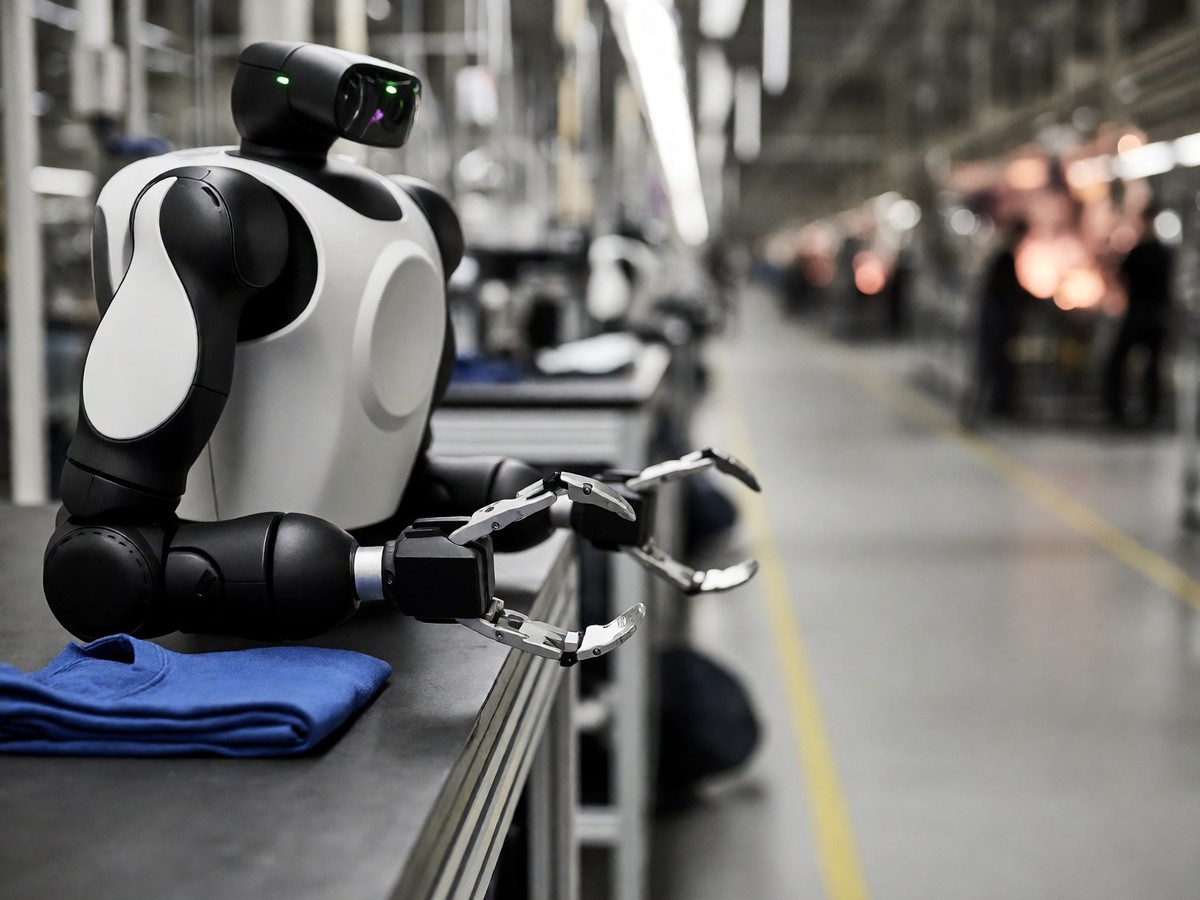
Toyota plans to deploy 400,000 robots starting in 2028 to automate global factories. The automaker expects this automation effort to cost $6.4 billion annually. Of these machines, 150,000 will operate in Toyota plants and 250,000 will serve group company facilities. Toyota uses the Eley humanoid, a 50 kg wheeled robot with two-fingered hands, to learn tasks by observing workers. This robot folded T-shirts with near-perfect accuracy after 1,500 practice sessions over two weeks. The company also maintains a commercial Robots-as-a-Service agreement with Agility Robotics to deploy Digit humanoid robots for logistics at its Woodstock, Ontario plant. If you believe hardware ownership dictates market dominance, reconsider the Toyota and Physical Intelligence intersection. Toyota’s investment in AI includes a $1.5 billion fund for startups and a planned $10 billion investment in US operations announced in November 2025. This follows a $11.2 billion investment plan for growth technologies announced in May 2024. The company also uses a joint venture with Pony.ai to mass-produce b Z 4 X-based robotaxis in China as of 2026. Toyota Research Institute works with Boston Dynamics to develop Large Behavior Models for humanoid robots like Atlas. Toyota also partners with NVIDIA to use the DRIVE AGX Orin platform for its next generation of vehicles. The company aims to capture the expertise of 18,000 veteran "takumi" workers through training data. Toyota’s history with partner robots includes development that commenced in 2000 and a presence at the 2005 World Exposition in Aichi, Japan.