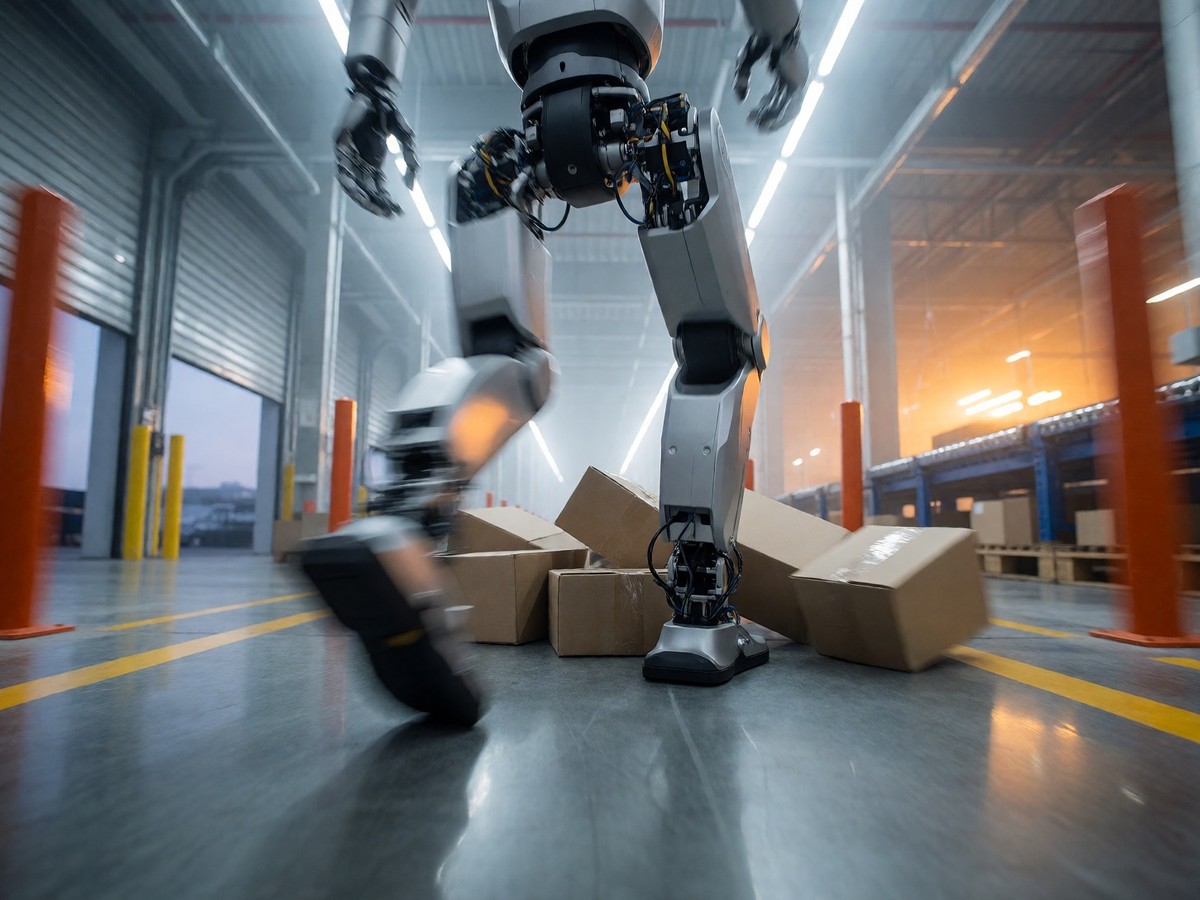
Skild AI commands a $14 billion valuation after raising nearly $1.4 billion in new funding led by SoftBank in early 2026. This capital brings total funding above $1.8 billion. The company targets construction, manufacturing, and security robots with its Skild Brain foundation model. This software layer controls diverse hardware including humanoids, quadrupeds, and mobile manipulators.
Hardware-agnostic intelligence works
The Skild Brain functions as a centralized intelligence core that eliminates the need for custom code per task. It uses a hierarchical structure where a high-level policy handles navigation and intent while a fast low-level controller manages joint angles and torques. This separation allows robots to climb stairs with balance recovery or pick up irregular objects. You should recognize that this approach avoids the massive capital expenditure required to build proprietary robot bodies. Skild AI focuses on software rather than manufacturing aluminum limbs or high-torque actuators.
The model trains on roughly one thousand times more data points than competing approaches. It combines large-scale simulation, internet-scale human video, and real-world telemetry. The system uses NVIDIA Isaac Lab and NVIDIA Isaac Sim to simulate millennia of experience. It also incorporates NVIDIA Cosmos world foundation models to generate synthetic data for better sim-to-real transfer. These tools help the brain handle cluttered environments and recover from falls without task-specific programming.
| Capability | Specification/Detail |
|---|---|
| Total Capital Raised | Over $1.8 billion |
| Company Valuation | More than $14 billion |
| Training Data Scale | 1,000x more than competitors |
| 2025 Revenue | Approximately $30 million |
The platform enables rapid deployment because it requires minimal retraining for new tasks. However, the company faces a significant data bottleneck because physically grounded action data remains scarce compared to text or images.
Deployment across industries
Skild AI partners with ABB Robotics, Universal Robots, and Mobile Industrial Robots to integrate its intelligence into existing portfolios. It also works with Foxconn to control dual-arms on NVIDIA Blackwell GPU production lines. These deployments target high-precision assembly and logistics. In warehouse settings, Skild-powered robots sort diverse packages and navigate narrow paths.
The company provides an alternative to vertically integrated players like Tesla that build the entire stack. While Tesla focuses on its own Optimus hardware, Skild AI licenses its intelligence to any manufacturer. This creates a data flywheel where every deployed robot sends performance data back to improve the shared model. A quadruped learning to stabilize on ice informs how a humanoid handles a wet loading dock. One limitation remains the difficulty of performing fine manipulation of deformable items or transparent surfaces. Will the scaling laws for physical data eventually hit a wall?