Scaling and Reasoning Performance
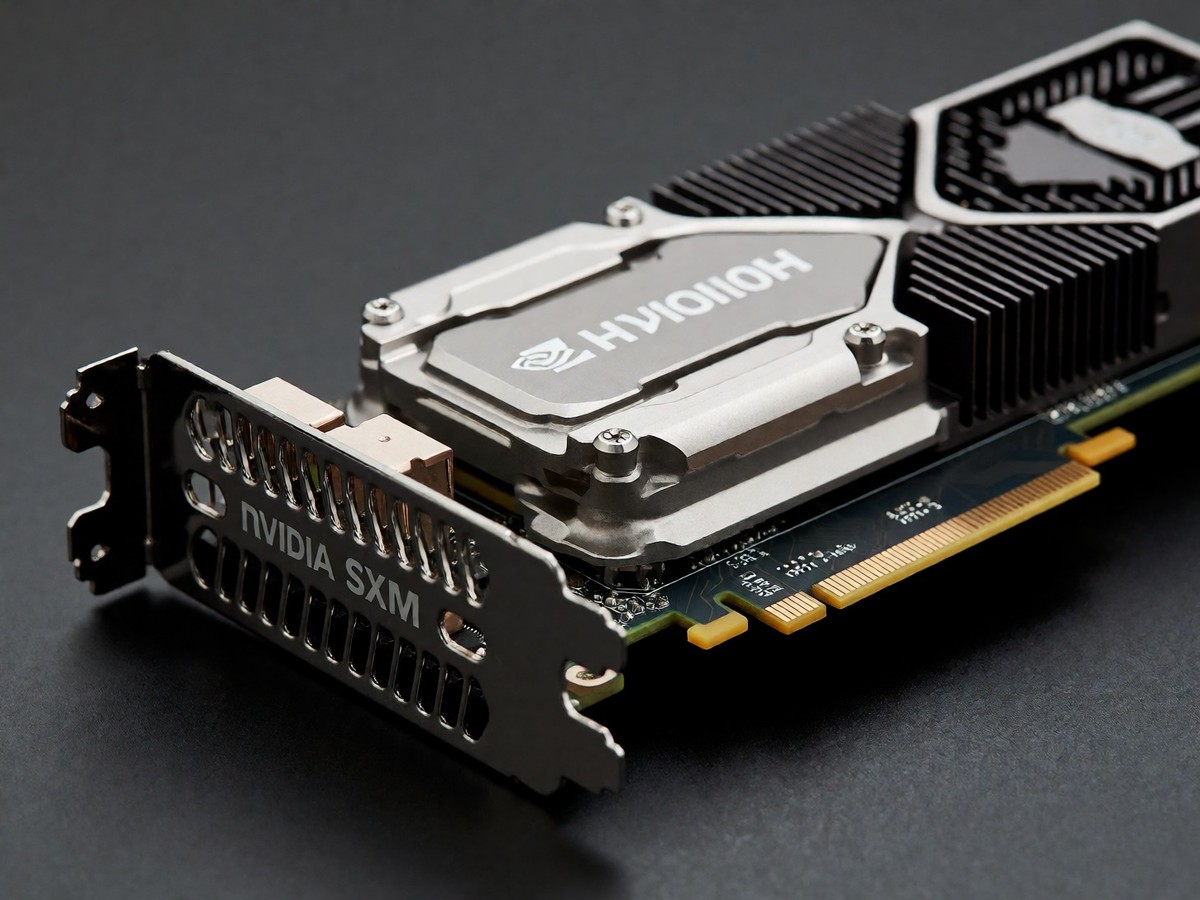
Nvidia’s B200 architecture outperforms AMD’s MI355X in high-interactivity reasoning tasks through superior networking and software orchestration. The GB200 NVL72 rack-scale system provides 15x the performance per dollar compared to current AMD offerings because its NVLink fabric scales more efficiently for Mixture of Experts models. At 250 tokens/sec/user, the B200 delivers 6.6x the throughput of the MI355X. The B200 has 192GB of HBM3e and 8 TB/s of bandwidth. This module requires a datacenter liquid cooling manifold and 1,000W per SXM module. At 110 tokens/sec/user, the B200 delivers more than 6x the throughput of the MI355X, which allows for much higher density in inference deployments requiring rapid response times for interactive users. At 100 tokens/sec/user, the B200 delivers nearly 3x the performance of the MI355X. For Llama 3.3 70B at 8K-in/1K-out, the B200 shows a 1.8x gap over the MI355X at baseline interactivity. The B200 also provides 4,500 dense FP8 TFLOPS and 9,000 sparse FP8 TFLOPS. For DeepSeek-R1 at 75 tokens/sec/user, the B200 provides 28x the throughput of the MI355X per GPU.
Memory Capacity and Inference Throughput
AMD’s MI355X targets large-scale production serving through 288GB of HBM3E memory. This capacity allows the MI355X to accommodate models larger than 13B parameters without activation checkpointing. The MI355X reaches 5,033 dense FP8 TFLOPS and 10,066 sparse FP4/FP6 TFLOPS. For 7B models at FP8, the MI355X reaches 3,000-5,000 tokens per second, while the MI300X serves 1,800-2,400 tokens per second. The MI355X requires 1400W and liquid cooling. The MI325X provides 256GB of HBM3E and 6 TB/s of bandwidth. The MI300X provides 192GB of HBM3 and 5.3 TB/s of bandwidth. Prefill latency for 4K tokens ranges from 35-55ms for the MI300X versus 18-35ms for the MI355X. On training workloads, the MI355X delivers 40-120% higher throughput for typical model sizes than the MI300X. Model FLOPS utilization reaches 42-55% on the MI355X compared to 38-48% on the MI300X. Fine-tuning a 70B parameter model with LoRA requires 40-80GB of VRAM. The MI300X’s 192GB of memory provides headroom to use larger batch sizes or skip quantization entirely to improve model quality.
| GPU | Memory | Bandwidth | FP8 Dense TFLOPS |
|---|---|---|---|
| Nvidia B200 | 192GB HBM3e | 8 TB/s | 4,500 |
| AMD MI355X | 288GB HBM3E | 8 TB/s | 5,033 |
| AMD MI325X | 256GB HBM3E | 6 TB/s | 2,615 |
| AMD MI300X | 192GB HBM3 | 5.3 TB/s | 2,615 |
| Nvidia H200 | 141GB HBM3e | 4.8 TB/s | 1,979 |
| Nvidia H100 | 80GB HBM3 | 3.35 TB/s | 1,979 |
Software Ecosystem and Cloud Economics
Nvidia’s CUDA ecosystem maintains a community 10-20x larger than AMD’s ROCm. Software optimizations in ROCm 7 deliver 3.5x improvement in AI inference and 3x improvement in AI training over ROCm 6. The MI355X costs $28,000, whereas the B200 costs $35,000. If you are managing a startup budget, you know that picking the wrong chip can shave months off your runway. Some teams burn $15,000 to $40,000 per month on idle GPUs alone. The MI300X costs $2.20 per hour in the cloud, while the H100 costs $1.49 per hour on Lambda Labs. Microsoft Azure provides MI300X instances in Sweden and Ireland as lower-cost alternatives to H100 instances. AMD GPUs generally cost 20-30% less than equivalent Nvidia chips at the cloud level. For most early-stage founders, Lambda Labs or RunPod provides the best balance of price and reliability. A 2,000-GPU B200 rollout supporting foundation model training results in a total monthly run-rate of $21.5-22.1M when including power, cooling, and networking. This includes $1.0M for power, $450-650K for facility and cooling, $225-325K for network fabric, and $180-260K for operations staff. Will AMD’s MI400 series bridge the gap in 2026?
| GPU | Lambda Labs | RunPod | AWS |
|---|---|---|---|
| H100 80GB | $1.49/hr | ~$1.99/hr | ~$3.50/hr |
| H200 141GB | ~$2.50/hr | ~$2.89/hr | ~$5.00/hr |
| MI300X 192GB | – | ~$1.50/hr | – |