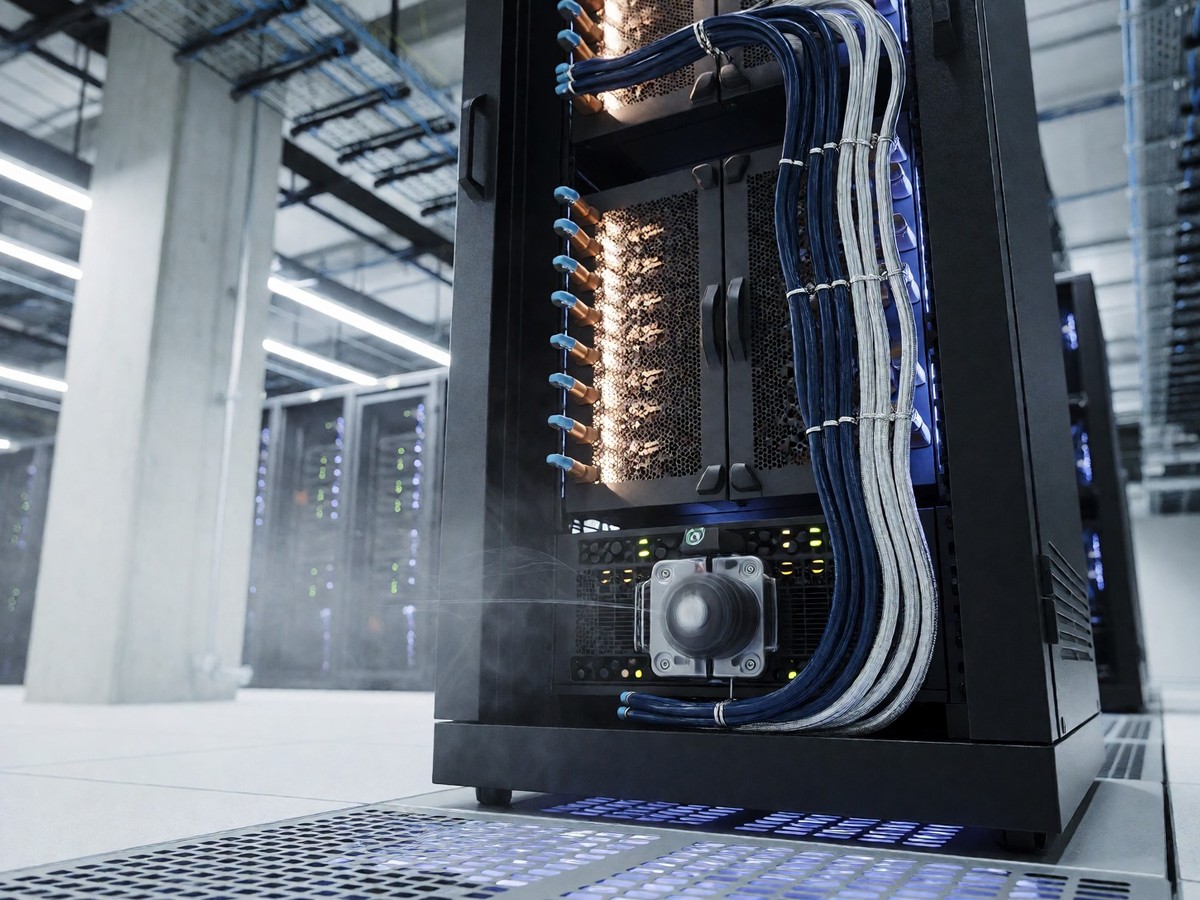
The GB200 NVL72 rack draws 120kW of power, which exceeds the 8 to 25kW limit of standard air-cooled server racks by five to fifteen times, which makes traditional airflow optimization insufficient for these high-density workloads. The GB200 GPU die operates at a heat flux of 500 to 600 W/cm2, a level comparable to nuclear reactor fuel rods, while standard air-cooled heatsinks top out at 5 to 15 W/cm2. This density makes liquid cooling a mandatory architectural requirement. A single Blackwell B200 GPU consumes up to 1,000W. Traditional air-cooling systems cannot dissipate the heat generated by the B200. Even with high-CFM fans, air cooling fails at these power densities. To keep up with these levels, data center air would need to be cooled to below-freezing temperatures or flow at near-gale speeds. Liquid cooling is 1,000x denser than air in its ability to carry heat away. The weight of the rack reaches approximately 1,360 kg before adding coolant, which pushes the total toward 1,500 kg. This weight requires reinforced concrete slab construction for many data centers. If air cooling were possible, the fan power would consume 20 to 30% of the rack’s compute power and generate 90 plus dB of noise.
The liquid cooling assembly
Direct-to-chip liquid cooling transfers heat through a specific loop. The system contains 36 GB200 compute trays, each holding a module with two B200 GPUs and one Grace CPU. These trays connect to a rack manifold via a common supply and return line. The manifold ensures balanced flow, typically within 5% per branch. The system relies on cold plates to move heat from the silicon into the moving coolant.
| Component | Thermal Load / Spec | Cooling Requirement |
|---|---|---|
| GB200 Module | 1,200W + 1,200W + 300W | Direct-to-chip cold plate |
| NVL72 Rack | 120kW+ | Liquid-cooled rack with CDU |
| Cold Plate Flow | 2.5 L/min | 25 +/- 2 °C water |
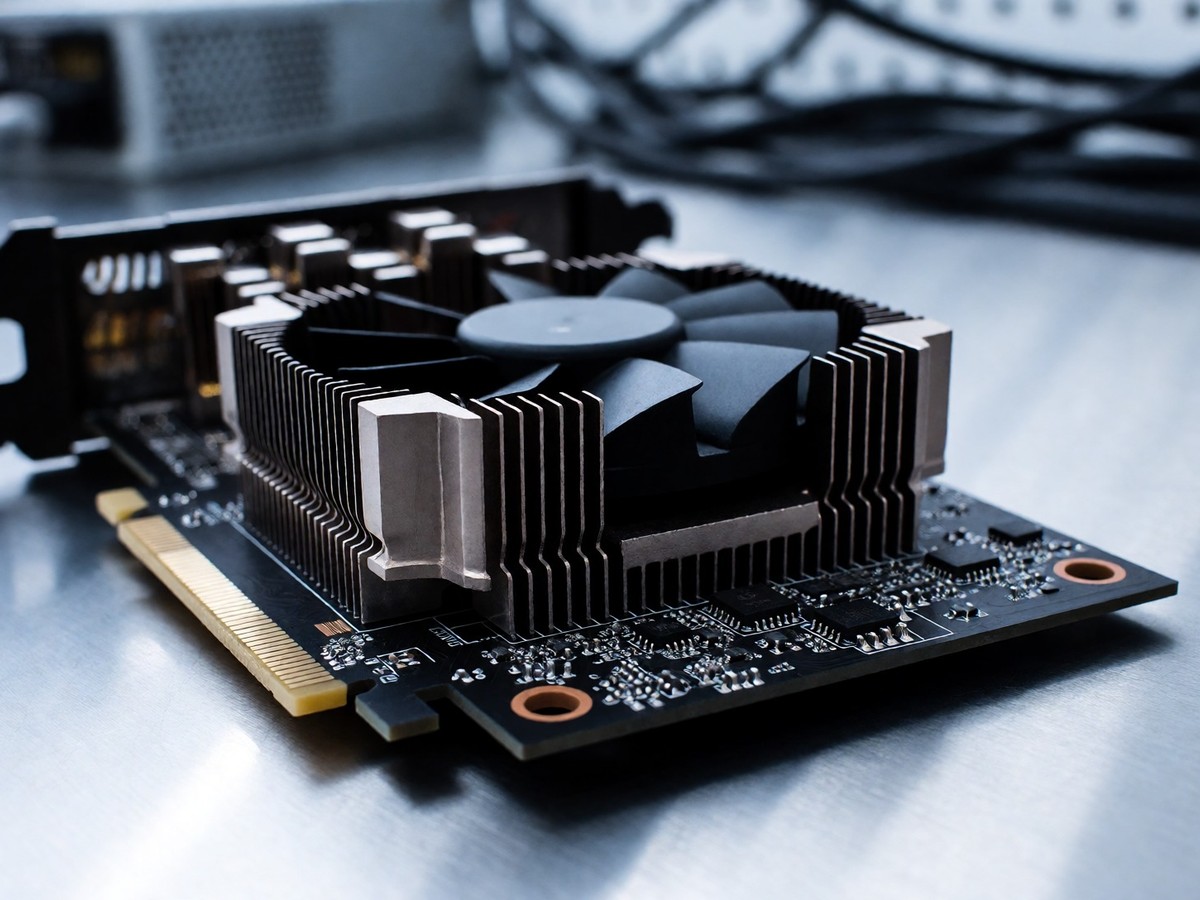
The cold plate kit, such as the TC-BZP-GB200-01A, uses T2 copper and nitrogen-protected brazing plus laser welding. It must handle a pressure rating of 0.6 MPa with a pressure drop of 35 +/- 5 kPa. You likely understand that thermal expansion stress from heat can cause early failures in the interfaces. The contact surface flatness must stay below 0.05 mm over the die contact area. A surface roughness of Ra <= 0.8 mm ensures minimal thermal interface material variation. The design includes micro-channel or turbulator internal fins to maximize the heat transfer coefficient. The cold plate must accommodate the specific NVIDIA mounting hole pattern and torque specifications. Every unit undergoes pressure and leak testing before shipment. The system uses 2.5 L/min of 25 +/- 2 °C water to manage the heat. Engineers must use CFD simulation to validate flow distribution uniformity across the die footprint.
The heat path and efficiency
The heat path follows a specific relay: the chip, the cold plate, the coolant, the manifold, the CDU, and the facility loop. The Coolant Distribution Unit (CDU) handles the handoff to the facility water using a liquid-to-liquid heat exchanger. This setup keeps the two loops separate to allow for different materials and maintenance practices. The CDU manages flow, temperature, and pressure for the entire rack. The CDU connects the rack to the building chilled water or an evaporative cooling tower. The CDU has four jobs: move fluid, move heat, protect hardware, and create evidence. It provides telemetry for temperature, flow, pressure, filter delta-P, conductivity, pH, particulate loading, and leak status.
Liquid cooling captures heat at the source to improve efficiency. This method enables data centers to operate with warmer water, which reduces dependence on mechanical chillers. The GB200 NVL72 delivers 25x cost savings and 300x more water efficiency than traditional air-cooled architectures. Data centers spend between $1.9M and $2.8M per megawatt per year on cooling. A 50 MW hyperscale data center achieves over $4 million in annual savings by using this system. The GB200 NVL72 provides 30x higher throughput and 25x more energy efficiency than older architectures. The system supplies chilled water at approximately 18 to 25 degrees Celsius and handles a return temperature of 40 to 50 degrees Celsius. Does the rising demand for these liquid-cooled racks outpace the availability of specialized data center power?