Valuation and the Shift Toward Inference
SambaNova Systems reached an $11 billion post-money valuation following the first close of its $1 billion Series F round in July 2026. General Atlantic led the round with participation from T. Rowe Price, Capital Group, and Seligman Ventures. New and existing investors include A&E Investment, Assam Ventures, Battery Ventures, Cambium Capital, BlackRock, Intel Capital, Kabila Capital, QFO Capital, Qatar Investment Authority, Vista Equity Partners, and Volantis. This funding follows a $350 million Series E in February 2026 and a $676 million Series D in 2021. The company reported roughly $100 million in annual revenue in June 2025. Rodrigo Liang, the CEO, intends to use the capital to secure the supply chain for orders over the next 12 months. This funding brings total raised capital to $2.5 billion. In the previous round, the company passed a $5 billion valuation. Earlier, Intel rumored an attempt to buy the company for $1.6 billion. Since the company’s founding in 2017, the focus moved from training workloads like voice and image recognition to the massive scale of inference. Inference consumption rose more than 100x over two years, while per-token unit prices dropped by an order of magnitude.
Hardware Efficiency and Enterprise Adoption
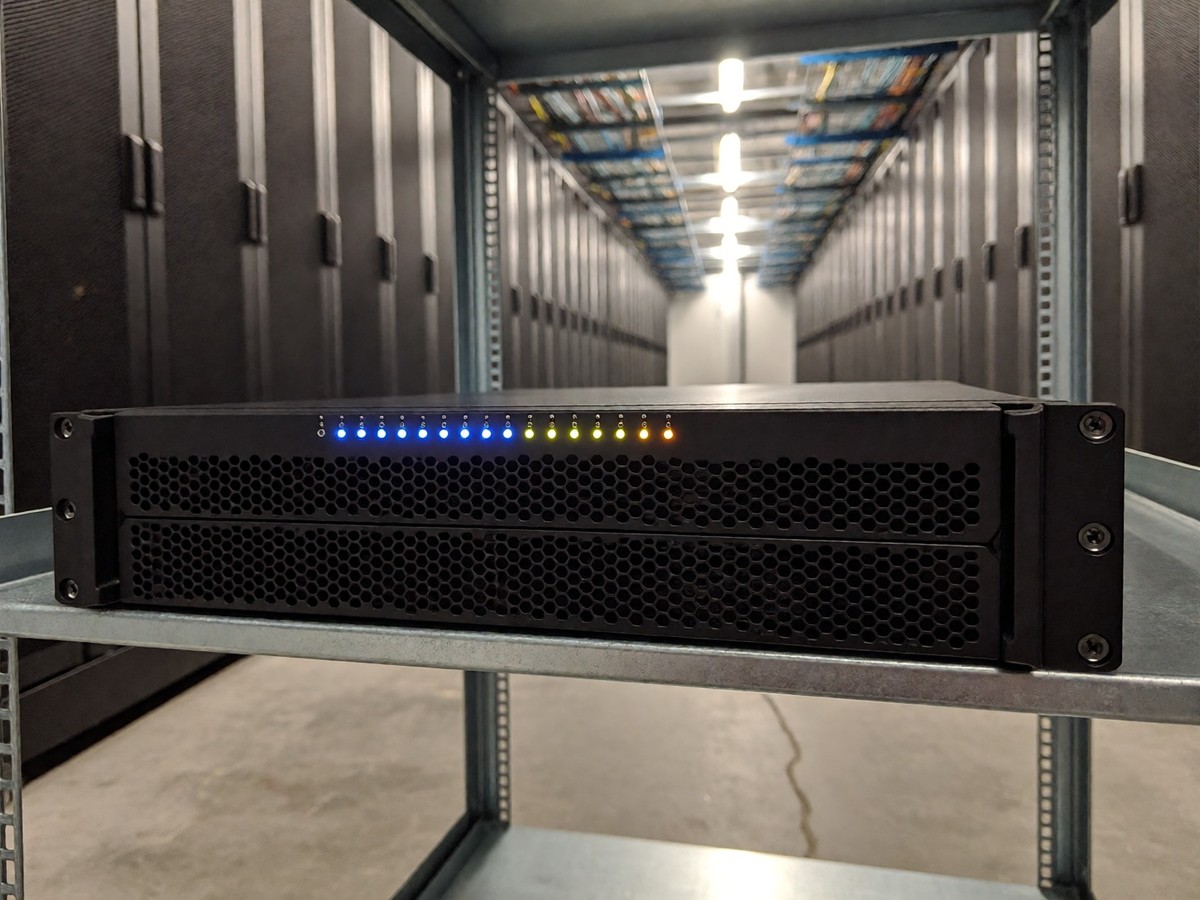
The SN40L rack uses 16 chips in a standard 19-inch air-cooled form factor and delivers 10.2 PFLOPs, which allows it to function in existing data centers without the liquid cooling requirements of heavier systems. While the NVIDIA GB200 NVL72 draws 130 to 132 kW at full load, the SambaNova rack pulls only 10 kW. This performance is much higher than the 7.6 kW industry-average rack reported by the Uptime Institute in 2025. The SN40L uses a 5nm TSMC dual-die design with 102 billion transistors, 640 BF16 TFLOPs, and 520MB of on-chip SRAM. It also uses a three-tier memory system combining SRAM, HBM, and off-package DDR DRAM. This setup allows the hardware to load trillion-parameter models in a single rack, whereas other providers require 10 to 20 racks to load similar models. The SN40L runs models like DeepSeek R1 671B and Llama 4 Maverick directly in its configuration.
| Component | SN40L Specification |
|---|---|
| Chip Count | 16 chips per rack |
| Power Consumption | 10 kW |
| Performance | 10.2 PFLOPs |
| Manufacturing | 5nm TSMC |
| Memory | SRAM, HBM, and DDR DRAM |
Aramco signed a memorandum of understanding with SambaNova to investigate methods for enhancing AI capabilities and fostering innovation across the Kingdom. JPMorganChase also selected the company as an inference-infrastructure partner to power secure, on-premises AI inference using both SN40L and SN50 systems. The company also maintains a multi-year partnership with Intel to support AI inference development based on Intel Xeon chips. This collaboration includes an architecture combining GPUs for prefill, SambaNova RDUs for decoding, and Intel Xeon 6 processors for system orchestration. These deployments target the growing need for data privacy and sovereign AI. You should see these wins as validation for the company’s focus on the enterprise.
Performance Realities and the Verdict
Performance benchmarks for Llama 3.1 models show the SN40L outperforming many competitors. For the 405B model, SambaNova delivers 129 output tokens per second per user, while Fireworks achieves 72. For the 70B model, the SN40L provides 457 tokens per second, surpassing Cerebras at 445 and Groq at 250. On the 8B model, SambaNova hits 1042 tokens per second, although Cerebras remains faster at 1837. The SN40L RDU uses an optimizing compiler to fuse operations into large kernels, which avoids the launch overheads seen in traditional systems.
The company’s growth relies on premium inference for trillion-parameter models. Rodrigo Liang defines premium inference as the combination of model size and speed. This speed becomes essential for agentic workflows. If 20 agents each take two seconds to process a prompt, the response time reaches 40 seconds, which makes the service unusable. For Llama 3.3 70B, weights span roughly $0.12 to $1.05 per million tokens, depending on the provider. The SN50, scheduled to begin shipping in the second half of 2026, scales to 256 chips across racks to run models up to 10 trillion parameters with a context length up to 10 million tokens. SoftBank will act as the first deployment partner for the SN50. I find the ability to scale from a single rack to these massive models impressive. However, the massive capital requirements of the AI race create a significant risk. If the market prioritizes cheap, quantized models over high-precision output, SambaNova’s margin could shrink. Will the demand for sub-second latency in agentic workflows actually sustain these high-performance hardware costs?