In 2016, Graphcore raised $30 million to take on AI giants. In the autumn of 2016, the company secured its first funding round led by Robert Bosch Venture Capital. Other backers included Samsung, Amadeus Capital Partners, C4 Ventures, Draper Esprit, Foundation Capital, and Pitango. In July 2017, Graphcore secured round B funding led by Atomico, which was followed by $50 million from Sequoia Capital. In December 2018, Graphcore closed its series D with $200 million raised at a $1.7 billion valuation. Investors in that round included Microsoft and Samsung as well as Dell Technologies. On 13 November 2019, Graphcore announced that its Graphcore C2 IPUs were available for preview on Microsoft Azure. Softbank Group agreed to acquire Graphcore for approximately $500 million in July 2024. The UK’s Business Department investment security unit reviews this deal. This transaction follows Meta Platforms’ early 2023 decision to acquire the AI networking technology team from Graphcore. Graphcore operates with over 1,000 engineers in nine locations, including Bristol, London, Cambridge, Austin, Milpitas, Hsinchu, Taipei, Bengaluru, and Gdansk. Simon Knowles and Nigel Toon founded the British semiconductor company in 2016. The company seeks to build the future of AI compute by integrating specialized silicon and software with infrastructure at scale. While Softbank expands its AI ecosystem through this purchase, the regulatory review in the United Kingdom remains a hurdle.
Processor architecture and capacity
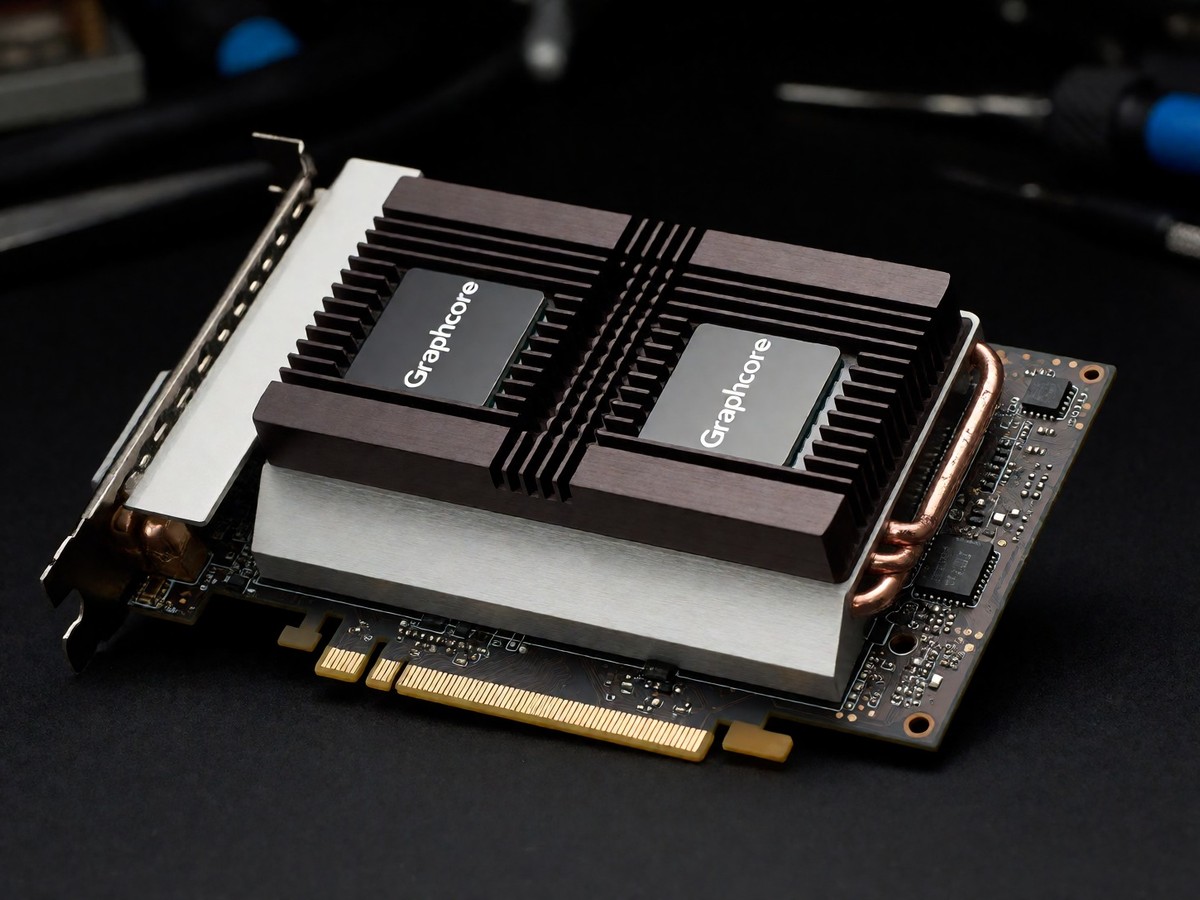
The Intelligence Processing Unit (IPU) holds the complete machine learning model inside the processor to ensure rapid access to data. This architecture relies on scratchpad memory for performance rather than traditional cache hierarchies. Graphcore released the Colossus GC2 in 2017 using a 16 nm process. The GC2 chip, packaged with two chips on a single PCI Express card called the Graphcore C2 IPU, performs the same role as a GPU in conjunction with standard machine learning frameworks such as TensorFlow. The second generation, the GC200, uses a 7 nm FinFET manufacturing process from TSMC. This chip contains 59 billion transistors and 1,472 computational cores. The device provides 900 Mbyte of local memory and supports 8,832 threads. The company also presented the Bow IPU, which consists of a 3D package that bonds a GC200 die face to face to a power-delivery die. This configuration allows for a higher clock rate at lower core voltage.
| Product | Process Node | Cores | Threads | Transistors |
|---|---|---|---|---|
| Colossus MK1 (GC2) | 16 nm TSMC | 1216 | 7296 | Not specified |
| Colossus MK2 (GC200) | 7 nm TSMC | 1472 | 8832 | 59 billion |
The hardware utilizes MIMD (Multiple Instruction, Multiple Data) parallelism. The device distributes local memory across the chip. Each tile in the GC200 chip contains about 630 KiB of memory. These tiles form islands, with four tiles per island. The IPU uses IEEE FP16 with stochastic rounding and single-precision FP32. The company’s global engineering force works across six different time zones to develop the end-to-end AI compute stack, which includes hardware, software, and infrastructure required to scale machine learning models in modern data centers.
Software stacks and enterprise intelligence
The Poplar Software Stack provides the graph tool chain for machine intelligence. Software engineers in Gdansk develop compiler and framework software to bring Triton and PyTorch support to new hardware. The Enterprise Graph Intelligence Platform unifies data from databases, APIs, documents, and streaming sources. This system provides Graph RAG infrastructure to give context to AI models. The engine analyzes meaning and context to surface connections. Organizations build knowledge graphs and scale them for enterprise use, allowing for the discovery of insights across organization data in hours rather than months. The platform converts siloed data into connected intelligence to power decisions across an organization. It allows no-code modeling and visual configuration alongside instant deployment. It connects to the existing stack via native integrations with databases, data lakes, and AI platforms.
Meta Platforms’ acquisition of the AI networking technology team in early 2023 stripped Graphcore of a necessary segment of its technology. You already know the IPU differs from a standard GPU, so focus on how the software translates hardware capabilities into performance. The platform allows users to capture evolving relationships between entities in real-time. The graph grows and adapts as data changes. Will the UK’s investment security unit block the Softbank deal?