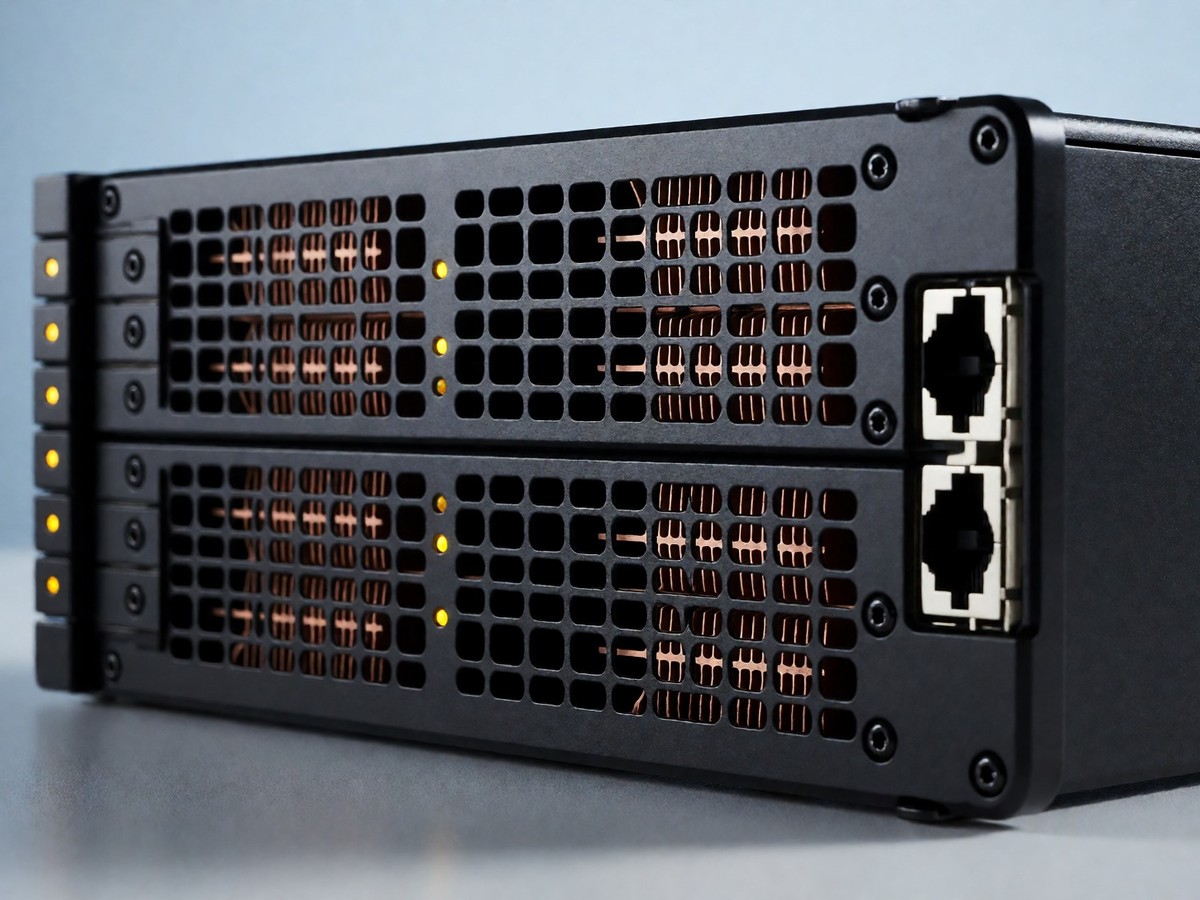
Tenstorrent Galaxy Blackhole systems start at $440,000 for a base supercluster of four servers, each delivering 23 PFLOPS Block FP8 compute from 32 chips. The architecture unifies compute, memory, and networking into a single system that scales via standard Ethernet without proprietary interconnects. This design eliminates the switch tax found in competing GPU clusters, which Tenstorrent claims yields a "10x TCO advantage" for data center design. The hardware generates 720p video in 2.4 seconds, a speed ten times faster than leading GPU systems according to Prodia Labs benchmarks.
Performance Metrics and Cost Structure
The Galaxy server packs 1 TB of DRAM with 16 TB/s bandwidth and 6.2 GB of on-chip SRAM operating at 2.9 PB/s. In Blitz Mode, the system achieves over 350 tokens per second per user on DeepSeek-R1-0528 671B, beating comparable GPU systems in both performance and capacity. Prefill latency drops below four seconds for 100K context windows, supporting batch sizes up to 128k. These figures rely on an open-source stack where 90% of HuggingFace models run natively through TT-Forge and TT-Lang interfaces.
| Spec | Tenstorrent Galaxy Blackhole | AMD MI300X |
|---|---|---|
| Memory Capacity | 1 TB DRAM (per server) | 192 GB HBM3 (per GPU) |
| Memory Bandwidth | 16 TB/s (aggregate) | 5.3 TB/s (per GPU) |
| Interconnect | 800G Ethernet | Infinity Fabric |
| Price Point | $110,000 (single server) | ~$30,000 (H100 equivalent) |
Enterprise deployments now include Virtu Financial for trading automation and ai& for Japan’s largest installation. Cirrascale CEO Dave Driggers called the hardware a "clean-sheet approach" that distinguishes itself from incremental competitors. However, critics note that earlier Wormhole benchmarks showed 4x to 5x lower throughput than H100s at equal batch sizes, with power usage also 4x higher. That legacy inefficiency contrasts sharply with current Blackhole claims, raising questions about whether architectural shifts fully resolved scaling costs.
Market Context and Competitive Reality
AMD reported record Q3 2026 revenue of $13.4 billion, driven by a 97% surge in Data Center segment sales to $8.5 billion. The MI300X remains a primary choice for memory-bound inference due to its 192 GB HBM3 pool, which fits 70B parameter models on a single card. Meanwhile, Super Micro Computer posted Q1 FY27 net sales of $19.9 billion, a 298% year-over-year increase fueled by AI data center demand. Tenstorrent raised $1.5 billion in October 2026 at a $6.2 billion valuation to scale these servers globally.
The cost efficiency argument hinges on GDDR6 being cheaper than HBM3, saving hundreds of dollars per chip. Yet operational scaling costs often negate theoretical savings, as seen in older Wormhole tests where buying four cards still incurred higher total expenses than one H100. You know the basics of GPU allocation, so consider this: does a 10x TCO claim hold when accounting for the engineering time required to write custom kernels in TT-Metalium? The software stack is fully open-source, but writing efficient code requires explicit data placement logic that CUDA abstracts away. This complexity creates a barrier for teams accustomed to managed frameworks.
Tenstorrent positions its solution as a general-purpose alternative to fragmented accelerator stacks, targeting agentic workflows and real-time systems. Equinix integrates Galaxy superclusters into its Distributed AI Hub, partnering with BetterBrain and OrionVM for orchestration. The company licenses its Ascalon RISC-V CPU and Tensix cores to Samsung and LG, expanding beyond direct hardware sales. Despite strong momentum, production scale remains unproven compared to NVIDIA’s decades-long ecosystem dominance. Buyers must pilot workloads end-to-end to verify if the promised efficiency translates to actual budget savings. The gap between vendor benchmarks and real-world deployment costs remains the critical variable for enterprise adoption decisions.