The memory wall restricts AI performance. For autoregressive generation in modern LLMs, the binding constraint is memory bandwidth rather than raw math. Every time an LLM generates a word, it must load the entire model weights from memory into the processor. For a 70-billion parameter model like Llama 3.1 70B, this requires moving roughly 140 gigabytes of data through the memory system for every single token. At 100 tokens per second, this requires 14 terabytes per second of memory reads. The arithmetic intensity for decode at batch 1 is 1 FLOP per byte. The ridge point for an H100 in FP16 is 295 FLOP per byte. This creates a massive gap where the compute units sit idle. You already know that memory bandwidth limits LLMs. In a standard GPU cluster, the prospectus is stored in a warehouse across town. You have a fast truck, but the trip takes seconds. Cerebras moved the warehouse to the trading desk.
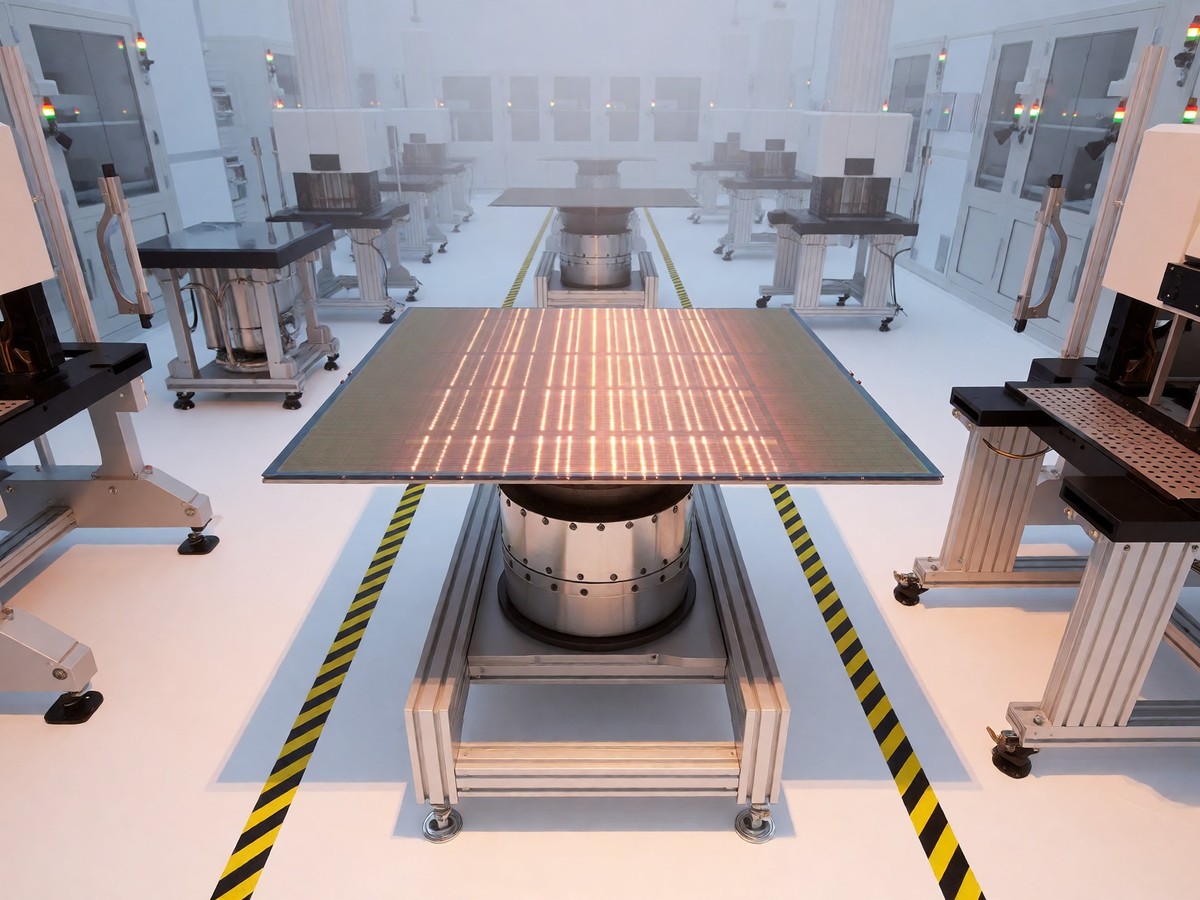
The WSE-3 is a square of silicon 21.5 centimeters to a side. It is 57 times larger than an NVIDIA H100. This chip uses nearly an entire 300-millimeter wafer of silicon. It contains 4 trillion transistors and 900,000 AI-optimized cores. The H100 has 80 billion transistors and 18,432 CUDA cores. The WSE-3 provides 44 gigabytes of on-chip SRAM. The H100 provides 80 gigabytes of HBM3. The WSE-3 delivers 21 petabytes per second of on-chip bandwidth. This is 7,000 times more than the 3.35 terabytes per second available in an H100. The reticle limit for a lithography scanner is approximately 858 square millimeters. The WSE-3 is 46,225 square millimeters. Cerebras uses 84 identical dies on a wafer and connects them with wires on the scribe lines.
Managing Defective Silicon
Cerebras uses a fail-in-place architecture to manage defects. A standard GPU chip is cut to specification after inspection, and manufacturers discard any defective chip. At wafer scale, you cannot cut around defects. The WSE-3 ships with approximately 70,000 dead cores by design. The interconnect fabric routes permanently around failures. The chip works through redundancy. There are 970,000 physical cores. 900,000 of these are active. The individual cores are 0.05 square millimeters. This is 1/120th the size of an H100 SM core. Silicon expands at 2.6 parts per million per Kelvin. The custom connector material absorbs the displacement caused by thermal expansion.
The system requires significant power and cooling. The CS-3 consumes 23 kW per system. This power is delivered through 300 vertical power delivery modules distributed across the wafer surface. The chip uses a proprietary water cooling system with 100 liters per minute at 20 degrees Celsius. A standard 42U rack fits 2 CS-3 systems. This configuration uses 46 kW and delivers 250 petaflops. An NVIDIA NVL72 rack with 72 B200 chips delivers 360 petaflops but consumes 132 kW. Cerebras provides 5.43 petaflops per kW. NVIDIA provides 2.73 petaflops per kW.
Hardware Specifications
| Feature | Cerebras WSE-3 | NVIDIA H100 | NVIDIA B200 |
|---|---|---|---|
| Transistors | 4 Trillion | 80 Billion | 208 Billion |
| AI Cores | 900,000 | 18,432 | (Not specified) |
| On-chip Memory | 44 GB SRAM | 80 GB HBM3 | (Not specified) |
| Memory Bandwidth | 21 PB/s | 3.35 TB/s | 8 TB/s |
| Fabric Bandwidth | 214 PB/s | 900 GB/s | 1.8 TB/s |
| Peak Performance | 125 Petaflops | (Not specified) | 20 Petaflops (FP4) |
Speed and Power Efficiency
Cerebras achieves 2,500 tokens per second for Llama 4 Maverick with 400 billion parameters, which is more than double the 1,000 tokens per second generated by the NVIDIA DGX B200 Blackwell system running the same model. For Llama 3.1 8B, the CS-3 delivers 1,800 tokens per second. This is 20 times faster than GPU alternatives. For Llama 3.1 70B, it delivers 450 tokens per second. The performance gap remains visible across different models. For Llama 2 70B, a cluster of 2,048 CS-3s trains the model in one day, while a Meta training cluster takes 30 days.
The cost of running generative AI scales with parameter count. Running ChatGPT could cost 1 trillion dollars annually if every person on Earth submitted requests. Cerebras works with Qualcomm to reduce inference costs by 10-fold. This partnership uses sparsity and speculative decoding to improve performance. Sparsity ignores zero-valued input to eliminate 80% of unnecessary computations. Speculative decoding uses a smaller version of a large language model to make predictions, then uses a larger version to check the answers. This consumes less energy than producing the output from scratch.
Software and Model Loading
The Cerebras software simplifies model training. Training the 175-billion parameter GPT-3 requires 20,057 lines of code on a GPU cluster. The WSE-3 requires only 565 lines of code. The architecture uses weight streaming. The chip keeps 44 gigabytes of SRAM on the wafer. Model weights stay in external memory like MemoryX. The system streams weights onto the wafer at the moment of calculation. This avoids the capacity limits of HBM. The WSE-3 supports up to 1,200 terabytes of external memory.
Each core has its own program counter and 48 KB of SRAM. Data arrival triggers computation via wavelets. A wavelet arrives on a color, and the bound task fires. This is a dataflow architecture. On a GPU, the program counter drives execution. On the WSE, data arrival triggers computation. If a weight is zero, no wavelet is sent. This allows for unstructured sparsity acceleration. The compiler maps the model onto the wafer. Each layer receives a rectangular region of cores. Data flows from one region to the next.
Enterprise Adoption and Scale
Cerebras has a 10 billion dollar contract with OpenAI signed in January 2026. OpenAI uses the hardware to diversify its training and inference infrastructure. The company also works with G42 on the Condor Galaxy 3 project in Dallas. This project uses 64 CS-3 machines. Other users include Meta, IBM, Mayo Clinic, and Mistral. Mayo Clinic uses the technology for cancer-drug response prediction. The Mayo Clinic model runs hundreds of times faster than conventional GPUs.
The company expands its infrastructure to meet demand. Cerebras is adding six new data centers in North America and Europe. These facilities include locations in Dallas, Minneapolis, Oklahoma City, Montreal, New York, and France. The company aims to increase inference capacity to 40 million tokens per second by late 2025. The WSE-3 supports models up to 24 trillion parameters. This is 10 times larger than current top-of-the-line generative AI tools.
The Verdict
I recommend the Cerebras WSE-3 for enterprises needing low-latency, high-throughput inference for massive models. The WSE-3 delivers 21 petabytes per second of memory bandwidth. This eliminates the memory wall. Will the high upfront cost of the CS-3 stop wider adoption in the mid-market?