Physical Intelligence leads the robotics race on the AI model layer with its pi0 foundation model, which utilizes a vision-language backbone and a flow matching action head to produce smooth, physically plausible action trajectories for various robot bodies. The company raised $400 million in late 2024 at a $2.4 billion valuation from investors including Jeff Bezos, OpenAI, Thrive Capital, and Lux Capital. Its pi0 model uses a vision-language backbone and a flow matching action head to produce physically plausible action trajectories. This model demonstrates cross-task generalization; a single checkpoint can pack boxes or clear tables. You already know that hardware alone does not solve the problem of unstructured environments. Physical Intelligence aims to be the intelligence layer that controls various robot bodies across different industries.
Figure AI leads on capital and manufacturing with a $39 billion reported valuation and a facility called BotQ that targets 12,000 humanoids per year. While Figure AI pursues vertical integration, Physical Intelligence focuses on the software brain. Skild AI also builds a body-agnostic brain and reached a $100 million annual revenue run rate 10 months after its first commercial deployment. Skild AI raised about $300 million in 2024 at a $1.5 billion valuation from SoftBank, Coatue, and Bezos. Skild AI uses NVIDIA infrastructure to train its S1 model, which learns new tasks from a single video demonstration. In tests, the S1 model succeeded 66% of the time at each step, which is a sevenfold improvement over an AI system that succeeded only 9% of the time. One operator recorded a demonstration for a plant-potting task, and the robot moved from that recording to autonomous execution in just 11 minutes. Physical Intelligence uses a proprietary dataset of over 1 million episodes across 10 embodiments to maintain this lead.
Physical AI addresses manual labor bottlenecks in inbound logistics
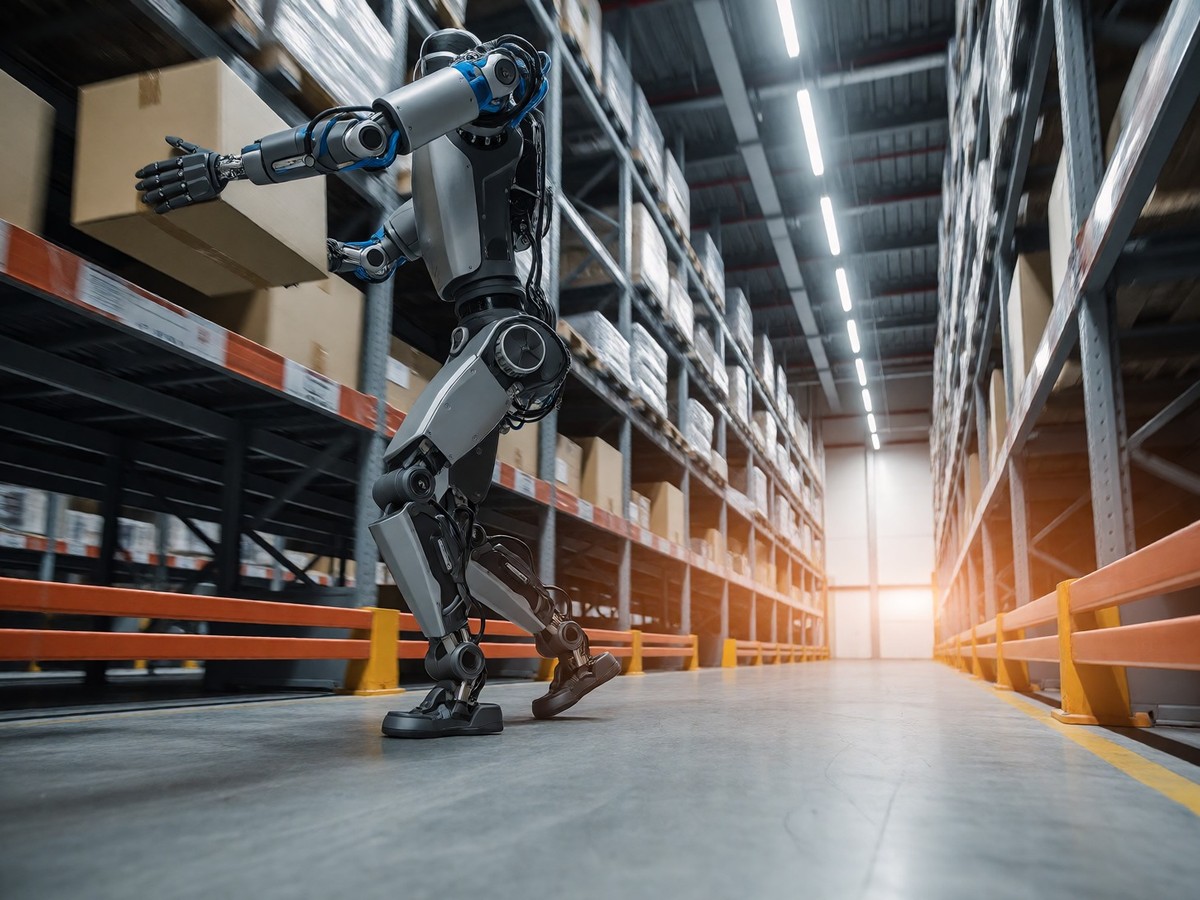
As of November 2025, 60% of U.S. warehouses integrated AI into operations, and predictions suggest 80% of warehouses and fulfillment centers will use AI-powered robotics within a few years. In Amazon’s SHV1 facility in Shreveport, Louisiana, which opened in September 2024, robots handle diverse tasks. Proteus robots lift and transport carts. Meanwhile, Sparrow, Robin, and Cardinal robotic arms load and sort goods. These systems reduce the need for humans to perform physically hazardous tasks like lifting heavy loads or bending down. The SHV1 facility spans five levels and 2.5 million square feet, and it employs over 2,000 people to manage the heavy workloads.
As the industry moves toward more autonomous operations, companies use robots to handle repetitive tasks like cycle counting with drones or delivering entire shelves via goods-to-person systems to increase overall warehouse efficiency. The global robotics market could reach $2.5 trillion in annual sales by 2035. Apptronik, which raised $350 million in early 2025 with Google, targets industrial and logistics work with its Apollo robot. Agility Robotics, the maker of Digit, has roughly $580 million raised and possesses the most real-world warehouse deployment experience, including pilots with Amazon. Companies often use robots-as-a-service to shift investments from a large capital expenditure to a predictable operating cost. Agility Robotics has roughly $580 million raised. Companies often use robots-as-a-service to shift investments from a large capital expenditure to a predictable operating cost. For a deployment to be successful, companies must start with a narrow, repeatable unit of work that provides clear inputs and outputs for the system.
| Model/Company | Type | Latest Valuation | Backers |
|---|---|---|---|
| Physical Intelligence | Foundation Model | $2.4 billion | Bezos, OpenAI, Thrive, Lux |
| Figure AI | Full-stack Humanoid | ~$39B (reported) | Microsoft, OpenAI, Nvidia, Bezos |
| Skild AI | Robot Brain | $1.5 billion | SoftBank, Coatue, Bezos |
| Agility Robotics | Warehouse Humanoid | ~$1.75B (est.) | DCVC, Amazon |
Safety and reliability remain hurdles
Research on robot foundation models shows success rates of 80% to 90% on certain tasks. This means these systems fail to complete a task at least 10% to 20% of the time when operating in unpredicted conditions. Physical AI safety risks include accidental harm, privacy violations, and malicious use. The Physical AI Safety Institute is a 501(c)(3) nonprofit that works to develop techniques to interpret, align, and control robot foundation models. Because robots interact with the physical world, a misaligned model has direct causal access to the world.
Human-robot interaction poses risks, as workers might enter an operational zone and face collisions. In 2015, a worker at a Volkswagen plant in Germany was crushed by a robot arm during installation. Programming errors also lead to accidents, such as when a robot applies excessive force due to faulty code. Mechanical failures, like hydraulic issues, cause robots to drop heavy objects. Companies must use predictive maintenance and sensor technology to detect human presence and slow down robots.
The industry faces a gap between a demonstration and reliable, generalized performance in unstructured environments. A system becomes meaningful when it performs useful work in a real-world environment with measurable outcomes rather than when it looks impressive on video. A deployment candidate must be able to perform a task that matters to the business and operate in the conditions where the work actually happens. The Bureau of Labor Statistics projects 17% growth for logisticians over the next decade. Will foundation models ever reach the reliability needed to operate without human intervention in every scenario?