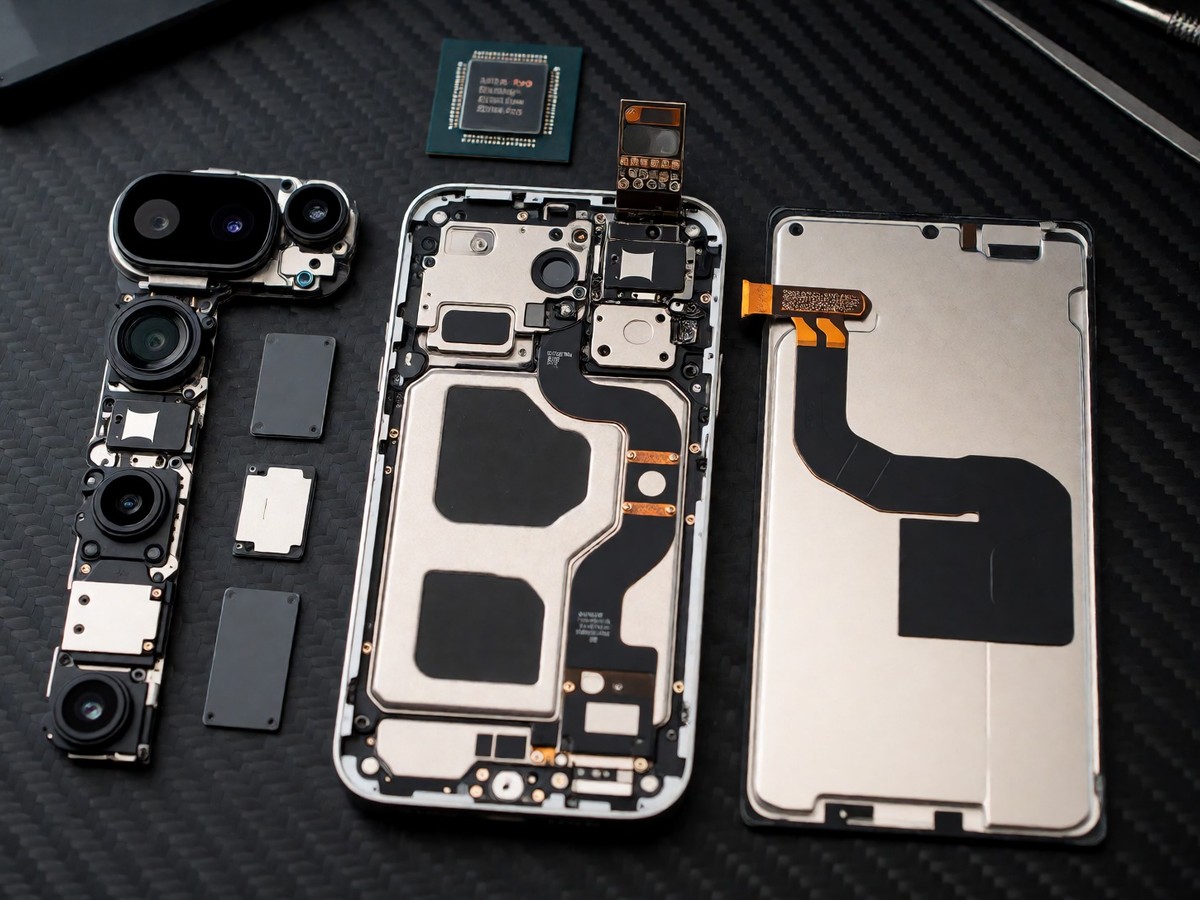
The A19 Pro chip includes an advanced 3 nanometer process and a sealed vapor chamber using deionized water to dissipate heat, which helps mitigate thermal issues during heavy workloads in the field. This hardware aims to allow longer takes with less thermal throttling during demanding tasks like 4K 120 fps video capture. The iPhone 17 Pro also includes three 48 MP rear sensors and a telephoto lens with a 56% larger sensor. This telephoto lens provides 8x optical-quality zoom with steps of 0.5x, 1x, 2x, 4x, and 8x. The device has a Super Retina XDR display with peak outdoor brightness near 3000 nits and a frame rate of up to 120 Hz.
The thermal management of these components is a primary concern for the stability of on-device AI. Intensive workloads like real-time AR, spatial mapping, or continuous on-device neural networking can push a modern iPhone to its absolute limits. When this happens, the aluminum chassis gets warm in the user’s hand. The operating system then takes defensive action to prevent the silicon from sustaining damage. The screen dims automatically to lower power consumption and reduce ambient heat display. The clock speeds of the CPU, GPU, and Neural Engine are severely reduced. Suddenly, a smooth 60 frames-per-second interface drops to a choppy 12 frames-per-second. The underlying tracking models begin to fail because the data pipeline is dropping crucial frame inputs.
Performance of the 3 billion parameter on-device model
The Apple Intelligence architecture uses a 3 billion parameter on-device language model to handle frequent, privacy-sensitive tasks. This model uses low-bit palletization to meet memory, power, and performance requirements. This technique uses a LoRA adapter framework with a mixed 2-bit and 4-bit configuration strategy. This strategy averages 3.7 bits-per-weight to maintain accuracy levels similar to uncompressed models. The model can reach 3.5 bits-per-weight without significant quality loss. For performance analysis, Apple uses an interactive model latency and power analysis tool called Talaria to guide bit rate selection for each operation.
On the iPhone 15 Pro, this approach reaches a time-to-first-token latency of about 0.6 milliseconds per prompt token and a generation rate of 30 tokens per second. This performance occurs before employing token speculation techniques. The on-device model uses a vocab size of 49,000 tokens. In contrast, the server-based model used in Private Cloud Compute uses a vocab size of 100,000 tokens, which includes additional language and technical tokens. Both models use grouped-query-attention to maintain efficiency. The adapter models are loaded dynamically, temporarily cached in memory, and swapped. These adapters use 16-bit values for the parameters. For the 3 billion parameter model, the adapter parameters typically require tens of megabytes.
| Metric | On-device Model Specification |
|---|---|
| Model Parameters | ~3 billion |
| Time-to-first-token Latency | 0.6 milliseconds per prompt token |
| Generation Rate | 30 tokens per second |
| Average Bits-per-weight | 3.7 bits |
| On-device Vocab Size | 49,000 |
| Server-side Vocab Size | 100,000 |
Hardware requirements and NPU efficiency
Apple Intelligence has a specific hardware floor. A device needs an A17 Pro chip or newer and at least 8GB of RAM to run these features. This requirement means the iPhone 15 Pro, the iPhone 15 Pro Max, the entire iPhone 16 line, and the entire iPhone 17 line are eligible. The standard iPhone 15 and the iPhone 14 cannot run Apple Intelligence. This hardware gate means that only a specific slice of the active device base can access the new AI capabilities.
On-device AI runs models directly on hardware like the phone or a wearable without a cloud connection. Dedicated chips called Neural Processing Units (NPUs) make this fast and efficient. Apple’s Neural Engine in the A18 Pro delivers up to 2x better performance-per-watt than running equivalent tasks on the CPU. Running large language model inference on a CPU at full load drains a standard 4,000 to 5,000 mAh battery in hours. An NPU performs inference tasks faster and with far less power than a GPU. Performance in NPUs is measured in TOPS, or Tera Operations Per Second. Higher TOPS means the device completes more AI tasks per second.
The physics of thermal throttling
You already know that mobile hardware faces physics. When the device reaches its thermal limit, the system must prioritize hardware safety over processing speed. This is the invisible wall that engineers face when building real-time mobile computer vision applications. If the thermal envelope is exceeded, the performance of the Neural Engine and GPU drops. This drop in speed affects how fast the AI can respond to user inputs.
The latency of on-device AI is usually under 10ms for common tasks. However, if the device is already warm from intensive tasks like 4K video or gaming, the thermal budget is much smaller. If the system reduces the clock speeds of the Neural Engine to prevent damage, the AI latency will increase. This increase in latency can make the interface feel sluggish. In real-time applications, such as live translation or AR, these delays are perceptible and frustrating. The system must balance the need for fast inference with the physical reality of an uncooled device.
Privacy and data security in the AI era
Apple Intelligence is designed to deliver personal intelligence without Apple collecting personal data. Most tasks run entirely on device. For more complex requests, the system uses Private Cloud Compute. This is a server-based intelligence system designed to handle requests while protecting privacy. The data being processed in Private Cloud Compute is not stored or made accessible to Apple. It is processed only to fulfill the request, after which the results are returned to the device and are not retained.
The servers in Private Cloud Compute use the Secure Enclave to protect encryption keys. They also use Secure Boot and a Trusted Execution Monitor to ensure that only signed and verified code runs. Independent researchers can inspect the code that runs on these servers to verify privacy promises. However, the integration of tools like ChatGPT into the Apple Intelligence stack creates new concerns. Users must be aware that when they use these tools, data may be shared with different providers.
The ability of Apple Intelligence to read and summarize emails in the Mail app also introduces risks. This feature can analyze bank statements, investment account details, and medical records. While Apple uses on-device processing to keep data local, some features may require off-device processing. This could expose sensitive information to unintended risks if the data is processed on Apple’s servers.
Compliance in regulated industries
For developers in the fintech and healthcare industries, Apple Intelligence introduces complexities regarding data handling. These applications must comply with regulations like GDPR, HIPAA, CCPA, and PCI DSS. These laws dictate how sensitive information is handled and often require explicit user consent. The possibility that Apple Intelligence processes user data off-device could conflict with these compliance mandates.
Security teams must evaluate if the automatic processing of financial or health data leads to violations. For example, under GDPR, processing personal data requires clear justification. If an app allows users to view medical reports, the interaction with AI might require specific privacy controls. Developers may need to design enterprise-level features that disable or restrict Apple Intelligence access to critical data. This ensures that sensitive information remains within a secure environment.
In a business setting, the use of AI is often unmanaged. A 2026 study shows that 78% of executives want to discipline AI use, but only 21% of employees report being aware of an AI policy. Furthermore, 34% of employees do not know which tools their employer has approved. This lack of governance can lead to company data being uploaded to unsanctioned models. Using local AI on Mac and iOS can reduce this exposure. Local AI keeps prompts and source material in a managed environment. This allows organizations to govern where data is processed and who can reach the model.
Leadership transition and the hardware strategy
Apple is undergoing a leadership transition as Tim Cook steps aside as CEO. John Ternus, the senior vice president of hardware engineering, will take over the role in September 2026. This change signals a shift toward a hardware-driven AI decade. Ternus has led the transition from Intel to Apple Silicon and has worked on many iPhone and Mac generations. The choice of a hardware engineer suggests that Apple believes the next decade depends on custom silicon and tight vertical integration.
The company is also changing its AI leadership. Amar Subramanya, a veteran of Google’s Gemini program, is the new head of AI. He is responsible for internal foundation models and on-device experiences. Apple has also signed a multi-year deal with Google to use Gemini. Gemini will power parts of the Apple Intelligence stack, such as search and writing assistance. This partnership provides a path to competitive AI experiences while Apple continues to develop its own models.
The strategic focus is on AI-centric devices. Apple has launched the M5 chip family with higher-throughput Neural Engines and AI-optimized GPU blocks. These chips are designed to handle larger on-device models. New MacBook Pro and MacBook Air models are positioned as AI laptops. Additionally, Apple is working on a foldable iPhone that may launch alongside the iPhone 18 family. This device will likely act as a showcase for AI-assisted multitasking and new interface patterns.
The balance of local and cloud intelligence
The architecture of Apple Intelligence splits workloads between the device and the cloud. The ~3 billion parameter on-device model handles small, frequent tasks. This includes writing tools, notification summaries, and Genmoji. These tasks are fast and private because they do not require a server. For heavier queries, the device uses Private Cloud Compute. This provides a way to access larger models without abandoning the privacy-first approach.
The verdict is that the hardware handles small, frequent tasks well, but the massive thermal requirements of real-time AI pose a threat to the user experience. The small features like Writing Tools and notification summaries work well. The headline feature, the contextual Siri, arrived 18 months after the initial demo. The hardware floor for Apple Intelligence requires an A17 Pro chip or 8GB of RAM. Will the thermal envelope ultimately limit the intelligence of the device?