
Part one ended on a claim: the limits of imitation learning are structural, and getting past them means training against outcomes rather than demonstrations. The clearest precedent for how that plays out is not in language modelling at all. It is in board games.
What Go taught us
The systems that surpassed human Go players combined two components. A network supplied intuition — given a position, which moves are worth considering, and how good does this position look. A search procedure then spent compute exploring the consequences of those candidate moves, playing lines out and backing the results up the tree.
Neither half is sufficient alone. The network without search plays fast and shallow. Search without the network faces a branching factor that makes exhaustive exploration hopeless. Together they produced play that was not merely superhuman but genuinely novel — moves that surprised professionals, found by a system that was never shown a human game containing them.
The decisive property was that Go gives you a free, perfect reward signal. The game ends and someone has won. You can generate unlimited training data by having the system play itself, and every game is correctly labelled at no cost.
Porting the idea to language
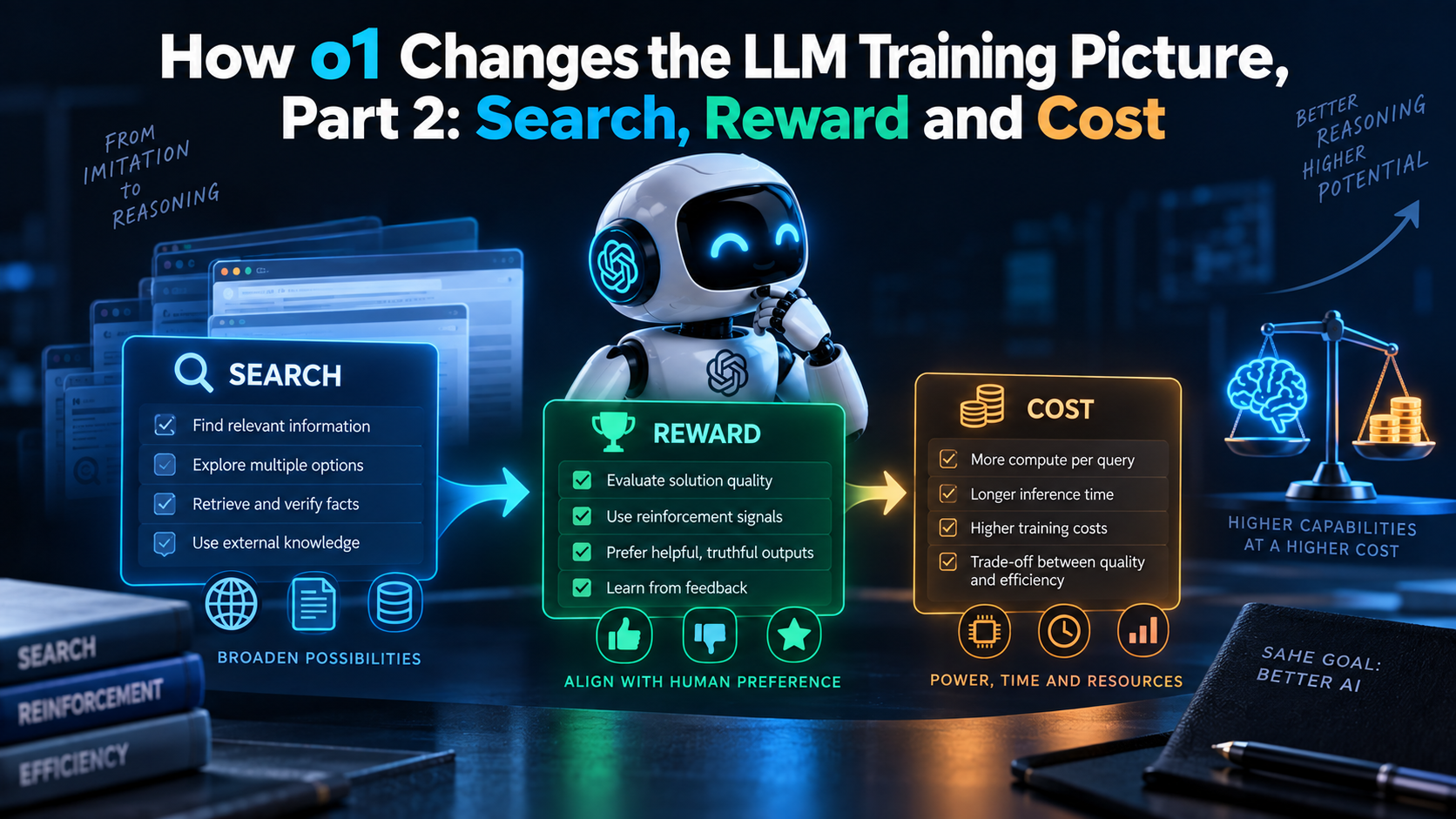
Reasoning models apply the same shape. The model generates reasoning chains, those chains are scored, and the model is trained to produce the ones that lead to correct answers. Inference stops being a single pass and becomes a search through the space of possible reasoning paths, with the model itself as the policy guiding that search.
This is why reasoning models exhibit a property no previous generation had: spending more compute at inference time reliably produces better answers. For a conventional model, generation length is roughly fixed by the task — a longer response is not a better-reasoned one. For a reasoning model, more thinking time genuinely buys more correctness, and that is a different scaling axis from parameter count and training data.
The reward problem, again
Go hands you the reward for free. Language does not. Mathematics and code are the closest analogues — a proof checks or it does not, a test suite passes or it does not — and the gains in those domains have been correspondingly large.
Outside them the picture is murkier. What is the reward for a well-argued essay, a sound piece of legal analysis, a good strategy memo? Reward models trained on human preference are the usual answer, and they are exploitable in exactly the way you would expect: optimise hard enough against a learned scorer and you find the places where it is wrong rather than the places where you are right. Elaborate hedging, confident phrasing and the appearance of rigour all score well without being any of those things.
So the honest expectation is uneven progress. Domains with crisp verification keep improving quickly. Domains where quality is a matter of judgement improve more slowly, and improvements there are harder to trust, because the thing you measured and the thing you wanted have quietly come apart.
What it means in practice
Reasoning is not free. These models are slower and substantially more expensive per task, and for the large majority of production work — classification, extraction, summarisation, routing — that expense buys nothing, because those tasks were never bottlenecked on reasoning depth.
Reach for a reasoning model when the task has a verifiable right answer and getting there takes several dependent steps. Use a conventional model everywhere else. The interesting consequence of this generation is not that one model got better; it is that “which model” is now a question with two axes, and inference budget became a dial you can actually turn.