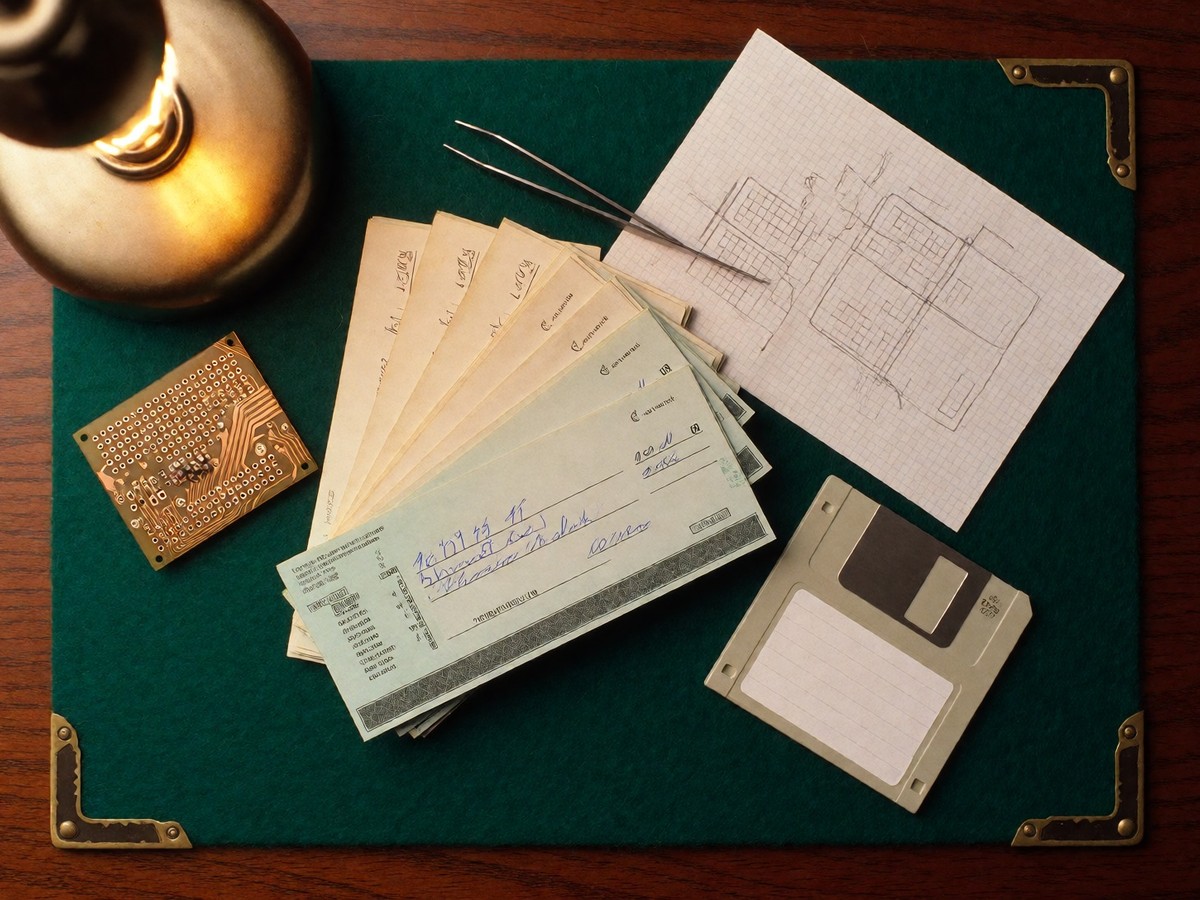
In 1988, Yann LeCun joined AT&T Bell Laboratories in Holmdel, New Jersey, with a specific mandate: build a system to read handwritten digits on bank checks. The neural network field was out of favor then, dismissed as computationally impractical by many researchers who saw it as theoretically limited. LeCun’s solution was architectural rather than brute force. He designed a Convolutional Neural Network (CNN) that imposed local connectivity and shared weights across spatial positions, drawing directly from neuroscience principles about the visual cortex. This approach allowed the model to learn features automatically instead of relying on hand-designed detectors like Sobel operators for edges. By 1998, the refined LeNet-5 architecture was processing a significant fraction of all checks deposited in the United States, running silently in banking infrastructure years before the term "deep learning" entered common usage.
The Architecture That Worked
The core innovation was rejecting fully connected networks, which treat image inputs as flat vectors and throw away spatial relationships. For a modest 256 by 256 pixel image, a traditional network would require millions of parameters in the first layer alone, making training difficult and inefficient. LeCun’s design used convolutional layers that scan inputs with small filters, typically 3×3 or 5×5 elements, to detect local patterns like edges and textures. Each neuron examines only a small region of the input, dramatically reducing parameter count while building in the assumption that local patterns matter for recognition. Pooling layers then downsample these feature maps, often using max pooling to take the largest value from non-overlapping windows. This operation introduces translation invariance, meaning the network remains robust if an object shifts slightly within the frame. The hierarchical structure allows early layers to capture fine-grained details like vertical edges, while deeper layers combine these signals to recognize complex shapes like wheels or eyes. I find this automatic feature learning to be the most powerful aspect of the design, as it eliminates the manual bottleneck of designing extractors for every new vision task. However, the original LeNet-5 was shallow and relied on tanh activation functions, which limited its ability to handle color images or high-dimensional data compared to later models.
From Obscurity to Industry Standard
Recognition for this work arrived slowly, with interest in neural networks ebbing through the 1990s and 2000s while LeCun continued his research at NYU’s Courant Institute. The ImageNet competition in 2012 changed everything when AlexNet, built on similar convolutional principles but trained on GPUs, demolished the competition and triggered the deep learning revolution. That moment vindicated the architectural choices LeCun had made two decades earlier, proving that CNNs could scale to massive datasets. In 2013, he became the founding director of Facebook AI Research, leading efforts that produced foundational tools like PyTorch. In 2018, he shared the Turing Award with Geoffrey Hinton and Yoshua Bengio, a trio often called the "Godfathers of Deep Learning." Today, convolutions remain the dominant method for processing natural signals from array sensors, including camera feeds, audio, and LIDAR point clouds. A study by Microsoft found that almost 90% of deep networks running on Android mobile devices are some kind of CNN. Yet, LeCun now argues that large language models are a "dead end" for achieving genuine intelligence because they lack grounded understanding of physical reality. His new venture, AMI Labs, aims to build "world models" that learn from physical dynamics rather than text prediction. Whether this shift will succeed remains an open question, but the foundation laid by LeNet-5 continues to power the current era of machine perception.