The economic gap in robotics
I see a massive economic gap between traditional robotics and the platform from Physical Intelligence. The pi0 model reduces the cost of a new task application to $10,000, whereas traditional custom programming costs between $500,000 and $2,000,000 per application. This pi0 model requires only 2 to 10 hours to learn new tasks through natural language instructions. Such speed contrasts with the 6 to 12 months normally needed to teach new behaviors to single-purpose machines. You already know that specialized robotics often fails, as 80% of such projects fail due to the need for PhD-level expertise. The pi0 model achieves an 87% task success rate using 3 billion parameters and 10 million hours of robot data. A single robot with pi0 intelligence can replace 5 to 10 single-purpose robots because it learns new tasks 100x faster at 1/50th the cost. The company raised $400 million in a Series A round in November 2024 with participation from Jeff Bezos, OpenAI, and Redpoint.
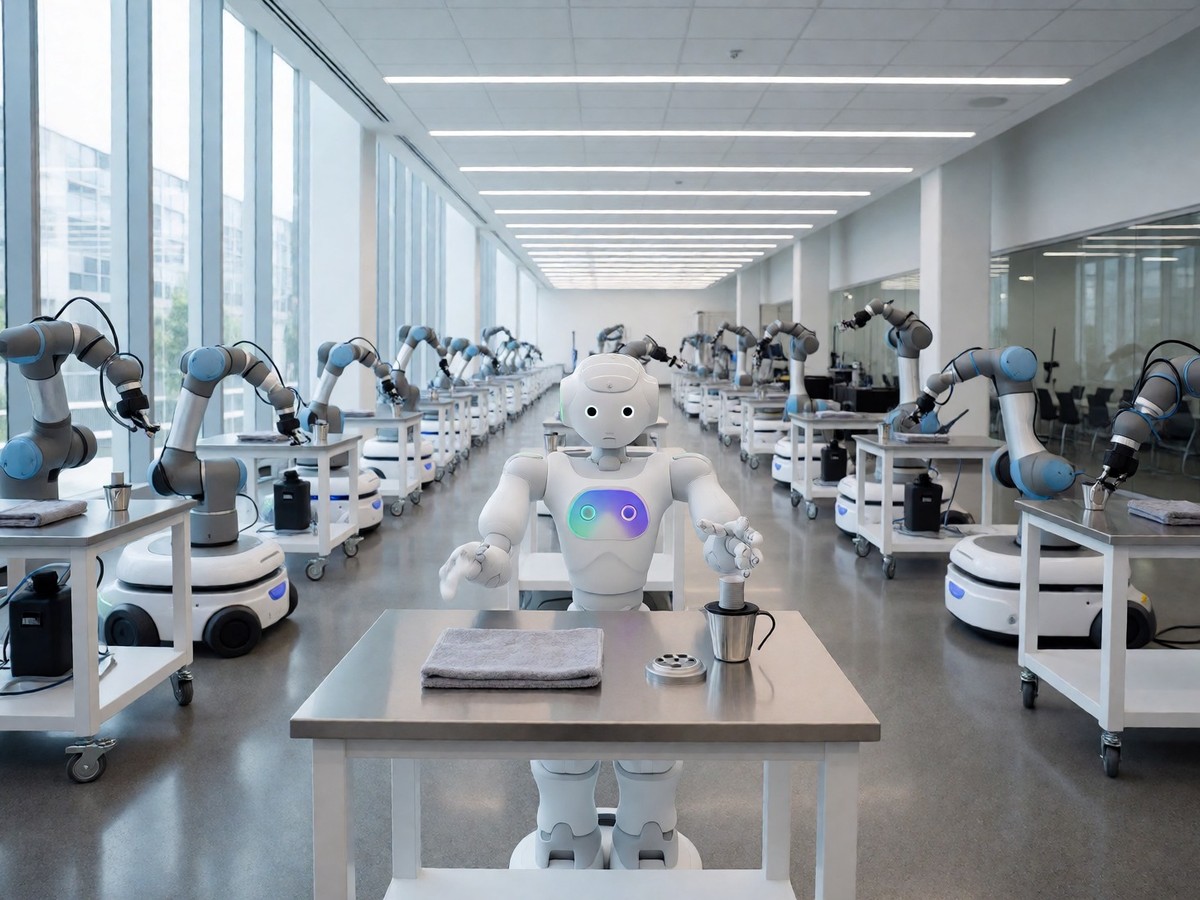
The founding team includes researchers from Google, Berkeley, and Stanford. They demonstrated tasks like folding laundry, loading dishwashers, clearing tables, and performing quality inspection. These capabilities address a $150 billion robotics market.
Technical performance and deployment
The pi0 model uses a flow-based transformer architecture trained on diverse robot demonstrations. This allows for zero-shot task generalization across 15 plus hardware platforms. Because the pi0 model works on any ROS2-compatible platform, robot manufacturers add generalist intelligence without building their own foundation models. The pi0.6 model, which arrived in November 2025, doubled throughput on dexterous manipulation tasks such as espresso machine filter insertion and cardboard box assembly.
| Feature | pi0 (Physical Intelligence) |
|---|---|
| Parameters | 3 billion |
| Training Data | 10M+ hours |
| Task Success Rate | 87% |
| Learning Time | 2-10 hours |
| Application Cost | $10,000 |
| Per-robot License | $100-$500/month |
To fine-tune pi0 for a new task requires only 50 to 100 demonstrations and a few hours of GPU compute. This efficiency contrasts with training a task-specific policy from scratch, which typically requires thousands of demonstrations and days of compute. Data collection for these 50 to 100 demonstrations takes approximately 8 hours of a skilled human operator’s time. The model handles tasks with complex temporal structure through its flow-matching generative architecture. I find the ability to teach tasks in plain English to be the most effective way to replace rigid, code-based systems. The RECAP training method, which uses reinforcement learning with experience and corrections via advantage-conditioned policies, separates this from simple imitation learning. This distinguishes PI from Google DeepMind’s RT-2, which embeds control within a language model but faces slow inference, and Skild AI, which focuses on humanoid locomotion. The company uses a proprietary data collection pipeline and multi-robot fleet learning to improve. This data flywheel strengthens the competitive moat for the foundation model.
Scaling the intelligence layer
The PI business model relies on per-robot licensing of $100 to $500 per month or enterprise agreements. This differs from competitors like Boston Dynamics, Figure, and 1X, which pair their own hardware with their own or a partner’s model. PI targets the entire addressable market of every robot manufacturer by offering a hardware-agnostic intelligence layer. The company reached a $2.4 billion valuation in only eight months, and press reports in 2026 suggest that it may seek a further $1 billion raise at a valuation near $11 billion. While the pi0 model shows promise in tasks like folding laundry and loading dishwashers, I wonder if the 50ms inference latency remains stable during massive fleet deployments.
The company was founded in 2023 by former Google Brain researchers Sergey Levine, Chelsea Finn, and Karol Hausman. It raised $600 million in a Series B led by Alphabet CapitalG, alongside Lux Capital, Bond, Redpoint, and Sequoia Capital. PI’s distribution strategy focuses on robot OEMs, industrial automation companies, logistics providers, healthcare robotics, and service robot makers. They plan to partner with robot OEMs to pre-install intelligence and enable it via subscription. This strategy allows them to target markets including manufacturing facilities, restaurants, and hospitality. As the company moves from pi0 to the pi1 model in 2025 with 500 plus task capabilities, the market for robotic intelligence expands. The company targets 100,000 enabled robots by the end of 2025.