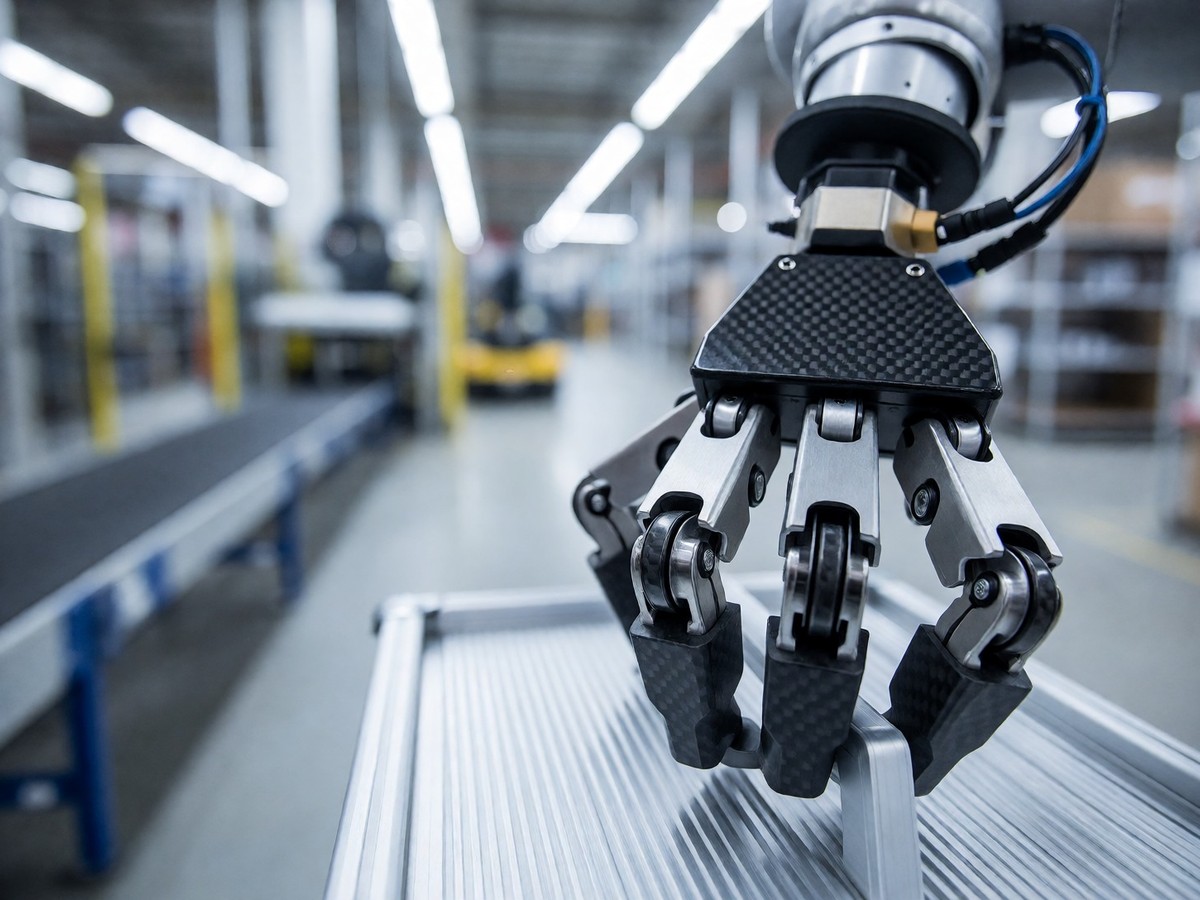
Physical Intelligence negotiates a $1 billion funding round at an $11 billion valuation. This investment would nearly double the company’s valuation in four months. The San Francisco firm develops pi 0, a vision-language-action model using flow matching architecture. This model accepts natural-language commands and controls various robot types for tasks such as making coffee, folding laundry, and assembling boxes. The founding team includes Karol Hausman from Google DeepMind, Sergey Levine from UC Berkeley, Chelsea Finn from Stanford, Brian Ichter from Google Research, and Adnan Esmail. Physical Intelligence raised over $1 billion across three rounds in under two years with backers including Jeff Bezos, NVIDIA, and Thrive Capital, aiming to prove that a single generalist model can control any robot. The company’s focus is on a pure-software strategy to avoid hardware competition. This approach allows pi 0 to control different robot embodiments, including mobile manipulators and bimanual systems. The pi 0 model integrates a ViT-based vision encoder, a language model backbone, and a flow matching action decoder into a single end-to-end trainable architecture. Because the company builds no hardware, its value is in the model layer that sits between human intent and robot action. However, the company lacks its own deployment data and depends on partners to provide the training data required to improve these models.
The Economic Barrier of Automation
The MIT study Beyond AI Exposure shows that only 23% of workers in computer vision tasks could be cost-effectively replaced by AI. High installation and operating costs for AI-assisted systems make human labor a more economical choice for most tasks. The research used online surveys to collect data on about 1,000 visually-assisted tasks across 800 occupations. Only 3% of such tasks automate cost-effectively today, but this could rise to 40% by 2030 if data costs fall and accuracy improves. The study, which was conducted by MIT FutureTech, The Productivity Institute, and IBM’s Institute for Business Value, found that researchers focused on applications such as property appraisal and teaching. While companies like Walmart and Amazon find favorable cost-benefit ratios in retail and warehousing, other sectors face steep financial hurdles. For example, automating quality control in a small bakery costs more than the wages saved from the task. I find the reliance on massive capital to bridge these cost gaps for foundation models to be a significant risk for the industry. The International Monetary Fund stated that almost 40% of jobs globally would be impacted by AI. Will the industry achieve widespread automation before the high cost of compute erodes the profit margins of foundation model companies?
Toyota’s Robotics Integration
Toyota plans to modernize 60 factories and requires approximately 400,000 robots, including both humanoid and non-humanoid systems. The automaker estimates annual expenditure for this modernization around ¥1 trillion starting in 2028. At the Woodstock assembly plant in Ontario, Toyota Motor Manufacturing Canada uses seven Agility Robotics Digit humanoids to handle repetitive material-handling tasks. These robots operate under a Robots-as-a-Service model to load and unload totes from automated tugger carts. Toyota also develops ELEY, a 50-kilogram wheeled robot that learns manipulation tasks from its 18,000 skilled production specialists. You should consider how these disparate automation strategies will eventually integrate into a single global manufacturing network.
| Feature | Agility Robotics Digit | Toyota ELEY |
|---|---|---|
| Form Factor | Bipedal humanoid | Wheeled with two arms |
| Weight | Not specified | 50 kilograms |
| Task Capability | Loading/unloading totes | Folding laundry/manipulation |
| Deployment Model | Robots-as-a-Service | Learning from humans |
Toyota demonstrated ELEY folding a T-shirt after the robot underwent 1,500 training repetitions over two weeks. This capability is built on large behavior models from the Toyota Research Institute to acquire manipulation skills. Toyota also aims to upgrade a robotics fleet of 150,000 units at Toyota and group companies and another 250,000 at suppliers. The company identifies parts transportation and picking as demonstration projects for its robotics applications. Hyundai, which owns Boston Dynamics, plans to introduce humanoid robots at its manufacturing operations in Georgia beginning in 2028.