Skild AI, a Pittsburgh-based company, reached a $100 million annual revenue run rate in September 2026. Founded in 2023 by Carnegie Mellon professors Deepak Pathak and Abhinav Gupta, the company holds a valuation above $14 billion. The funding history includes a $1.4 billion Series C in January 2026 led by SoftBank and Nvidia, a $500 million Series B in May 2025, and a $300 million Series A in July 2024. This capital allows the team to scale the Skild Brain, a foundation model that provides intelligence for various robot types. The model generalizes across perception, reasoning, and physical interaction, which prevents it from being tied to a single hardware platform. Massive datasets allow the model to manage tasks like manipulation, locomotion, and navigation across different machines.
Deepak Pathak and Abhinav Gupta have collaborated on robotics research for nearly a decade. Their work includes a 2017 paper on curiosity-driven learning. This expertise helped them build a model that challenges the idea that artificial general intelligence only arises from digital knowledge. The team includes experts from Meta, Tesla, Nvidia, Amazon, Google, and universities like Stanford and UC Berkeley. Skild AI is the leader in scaling foundation models for diverse robot hardware. The Skild Brain training process includes a self-play post-training method for its S1 model. This method used more than 140 years of simulated soccer experience before transferring policies to a physical humanoid. This approach allows the model to learn previously unseen tasks from a single video demonstration without fine-tuning. The company now operates with hundreds of robots at over 60 companies. While the scale of data is large, the model still struggles to resolve all edge cases in unpredictable physical environments. Can a software layer truly replace the need for hardware-specific design?
Hardware Integration and Specifications
The Skild Brain works with existing robotic hardware through software interfaces. Boston Dynamics produces Spot, a quadruped with 14kg of payload capacity and a flexible API for specific user needs. Spot performs autonomous charging and can replan its path around obstacles. The robot accommodates various payloads and allows for customization. Spot allows users to manage a fleet from six feet or six hundred miles away. The software helps manage the fleet and makes data accessible in one place.
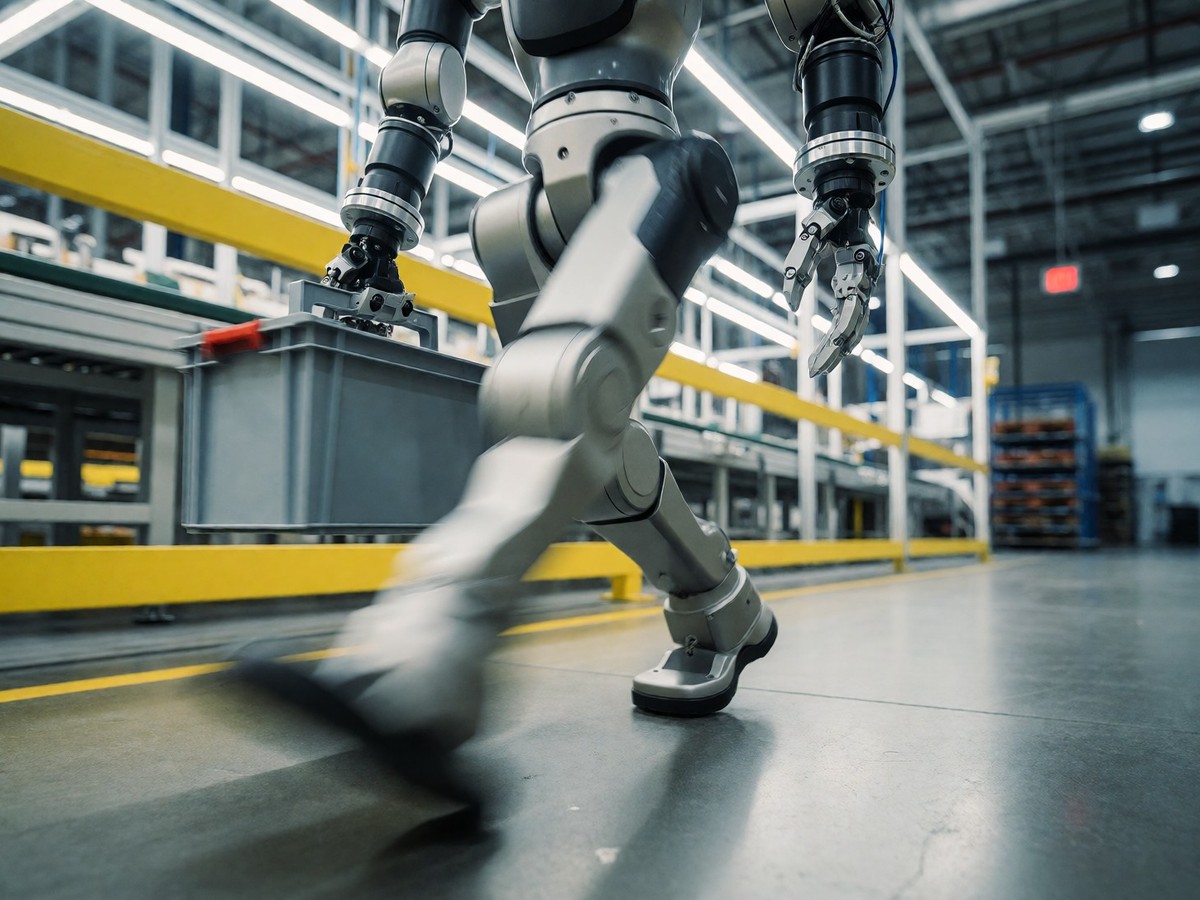
Agility Robotics produces the Digit 5 humanoid, which the company unveiled in September 2026. The Digit 5, which the company unveiled in September 2026, lifts 22.7 kg, which is 40% more than the previous Digit 4 version, and reaches a height of 2.2 m. The robot runs for 90 minutes on a battery that charges in 9 minutes. Charging takes only 9 minutes to provide a 10:1 run-to-charge ratio. You must compare these specific hardware capacities to understand the physical limits of current automation.
| Hardware Specification | Boston Dynamics Spot | Agility Robotics Digit 5 |
|---|---|---|
| Payload Capacity | 14kg | 22.7kg |
| Maximum Reach | Not specified | 2.2m |
| Battery Run Time | Not specified | 90 minutes |
| Charge Duration | Not specified | 9 minutes |
| Estimated Cost | Not specified | ~$200,000 |
The Digit 5 relies on swappable grippers with ISO flanges to handle many different types of industrial tasks. Agility Robotics expects early access to this model in the first half of 2027, with general availability by the end of 2027. The company reported more than $300 million in multi-year Digit orders in May 2026. The Digit 5 also uses a safety architecture with human detection, safety cues, and an independent safety controller. This architecture uses NVIDIA IGX Thor for its first launch partner.
Industry Demand and Deployment
Labor shortages create a massive market for adaptive robotics. The United States has 1.7 million more available jobs than unemployed workers. Manufacturing industries project 2.1 million unfulfilled jobs by 2030. Skild AI targets roles in construction, healthcare, and warehousing by using Nvidia H100 GPUs and Grace CPU chips to power its algorithms alongside hardware from partners like Samsung.
The Skild Brain works in factory environments through a deal with Nvidia and Foxconn. This setup provides a way to deploy robots in hazardous conditions, such as energized or radioactive areas. In these environments, robots can perform inspection and monitoring tasks to keep humans safe. The Skild Brain deployment reached a $100 million revenue run rate within ten months of its first commercial use. This growth happens as the company expands into logistics and manufacturing.
In the logistics sector, the Digit 5 handles tasks like tote handling, depalletizing, palletizing, machine tending, kitting, and sequencing. The humanoid was designed to work close to people without safety fences. The company provides an illustrative lease rate for the Digit 5 of about $8,500 per month, which includes software and maintenance, plus a $25,000 deployment fee. An alternative ownership model exists with an upfront cost of about $200,000, a $20,000 deployment fee, and roughly $36,000 a year for software and maintenance. However, the reliance on specific chip architectures like Nvidia’s Grace CPU means the software’s success depends heavily on external hardware availability.