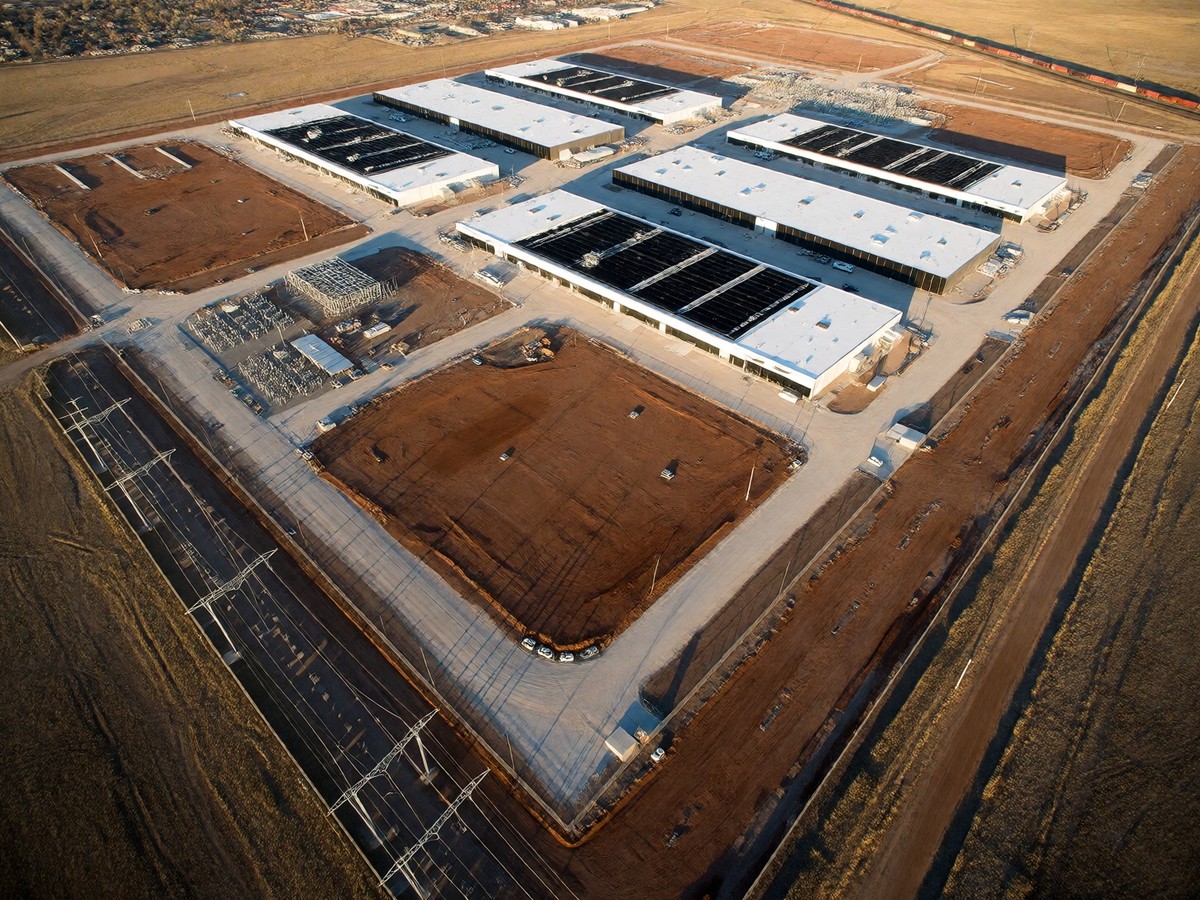
CoreWeave manages a $132.5 billion revenue backlog as of September 30, 2026, while its active power capacity reached 1.7 GW during the same period. The company rents its data center capacity from third-party developers rather than building its own facilities, except for a new campus in Kenilworth, New Jersey. Three major campuses, Denton, Polaris Forge 1, and Helios, provide 1.2 GW of critical IT capacity, with 645 MW currently operational as of early November 2026. The Denton site, located on 78 acres of city-owned land, houses over 100,000 NVIDIA Grace Blackwell GPUs used to serve OpenAI. CoreWeave pays a starting base fee of $100 per kW per month at Denton, which increases by 3.5% annually. Because CoreWeave lacks ownership of the land and buildings, its landlords like Core Scientific, Applied Digital, and Galaxy Digital carry the responsibility for grid connections and cooling systems. This dependency creates a risk where construction delays prevent CoreWeave from earning revenue from its multi-year, take-or-pay contracts.
| Campus | Status | Power Capacity | Starting Rent per kW |
|---|---|---|---|
| Denton | Operational | 262 MW | $100 |
| Polaris Forge 1 | Construction | Part of 1.2 GW total | $120 |
| Helios | Construction | Part of 1.2 GW total | $165 |
The company faces high capital intensity because it must pay for power and lease costs before customers begin using the installed GPUs. At Denton, CoreWeave funded most of the construction and conversion costs, paying approximately $8.5 million per MW. This upfront spending reduces ongoing rent, as Core Scientific applies the first $1.5 million per MW back as credits against monthly fees, capped at $393 million for Denton. I see the clear advantage in the Denton model because the sunk build costs make the capacity harder to abandon. However, CoreWeave’s reliance on a few customers creates a concentration risk, as Microsoft, OpenAI, and Meta accounted for 72% of revenue in Q2 2026. Microsoft alone contributed 36% of that revenue, while OpenAI provided 26% and Meta provided 10%. CoreWeave also manages a heavy debt load, with total debt reaching $46.9 billion as of the third quarter.
NVIDIA secures demand while Microsoft scales Azure capacity
NVIDIA provides a significant safety net for CoreWeave through an agreement where the chipmaker purchases any unused cloud capacity through April 2032. This $6.3 billion deal helps mitigate the risk that CoreWeave cannot fill its data center capacity beyond its largest clients. Microsoft also acts as a primary customer and a strategic competitor, as the company scales its own AI infrastructure to meet demand. Microsoft plans to increase its total AI capacity by more than 80% this year and intends to nearly double its data center footprint within two years. Microsoft’s management raised its capital expenditure guidance for fiscal 2026, stating that the growth rate for spending will exceed the 2025 rate. This aggressive scaling by Microsoft directly challenges CoreWeave’s position as a specialized provider. Microsoft’s Azure AI services demand continues to outpace available capacity, forcing the company to prioritize investment in short-lived hardware like GPUs and CPUs.
| Contract Participant | Agreement Type | Value / Detail | Term Ends |
|---|---|---|---|
| NVIDIA | Capacity Backstop | $6.3 billion | April 2032 |
| OpenAI | Cloud Capacity | $11.9 billion | 5 years |
| Meta | AI Cloud Capacity | $14.2 billion | December 2031 |
The competition between these entities shapes the pricing of GPU workloads. CoreWeave recently raised prices in its third quarter, with short-term capacity selling for more than $40 million per megawatt annually. In contrast, new infrastructure on four and five-year contracts moves at $20 million to $25 million per megawatt. I find the divergence in these rates tells you exactly how much premium customers pay for immediate access. Microsoft’s massive scale allows it to invest in its own specialized data centers, such as the Fairwater facility in Wisconsin, which aims for a 2-gigawatt load. While CoreWeave specializes in bare-metal performance and Kubernetes-native orchestration, Microsoft’s integration with its broader Azure ecosystem provides a different type of value. Does the massive capital advantage of Microsoft eventually allow it to squeeze neocloud providers out of the market?
Managing the costs of memory and power expansion
CoreWeave faces increasing pressure from the cost of high-bandwidth memory and the expense of servicing massive debt. The company expects capital spending to reach between $37 billion and $39 billion for 2026. This heavy spending coincides with a period where component costs, such as the memory needed for NVIDIA systems, remain volatile. Analysts have noted that CoreWeave has not publicly stated it hedged against rising memory prices, which could squeeze margins if the cost of building new fleets rises faster than contract revenue. The company’s third quarter net loss reached $709 million, while net interest expense hit $846 million for that quarter. To fund these expansions, CoreWeave uses several financial levers, including $9 billion in expected customer prepayments and loans backed by specific contracts.
| Financial Lever | Target / Detail | Status |
|---|---|---|
| Customer Prepayments | $9 billion expected | Next 3 months |
| Convertible Notes | $3 billion offering | Due 2033 |
| NVIDIA Deal | $6.3 billion | Active |
The company recently sought a $4 billion investment-grade delayed-draw term loan led by Morgan Stanley and MUFG. This loan aims to finance more than 90% of associated capital spending while avoiding the unsecured debt market, where yields recently topped 16%. CoreWeave’s strategy relies on the ability to turn future compute revenue into present financing through asset-level debt. The company continues to expand its contracted power, which reached 4.6 GW as of September 30, 2026. Despite the massive scale of operations, the company must still navigate the risk that demand for specific GPU generations might shift. I would watch the stability of the $40 million per megawatt short-term deals to see if the market continues to tolerate such high premiums.