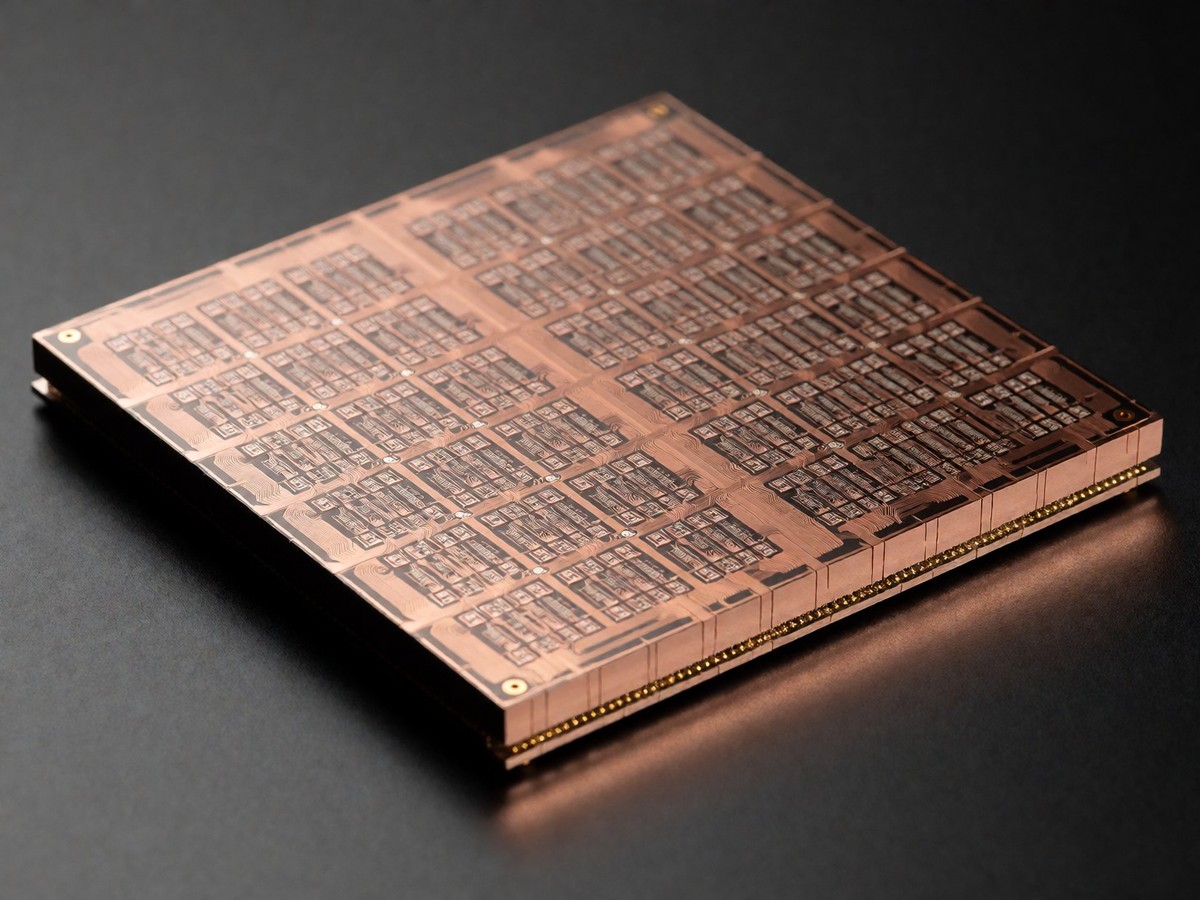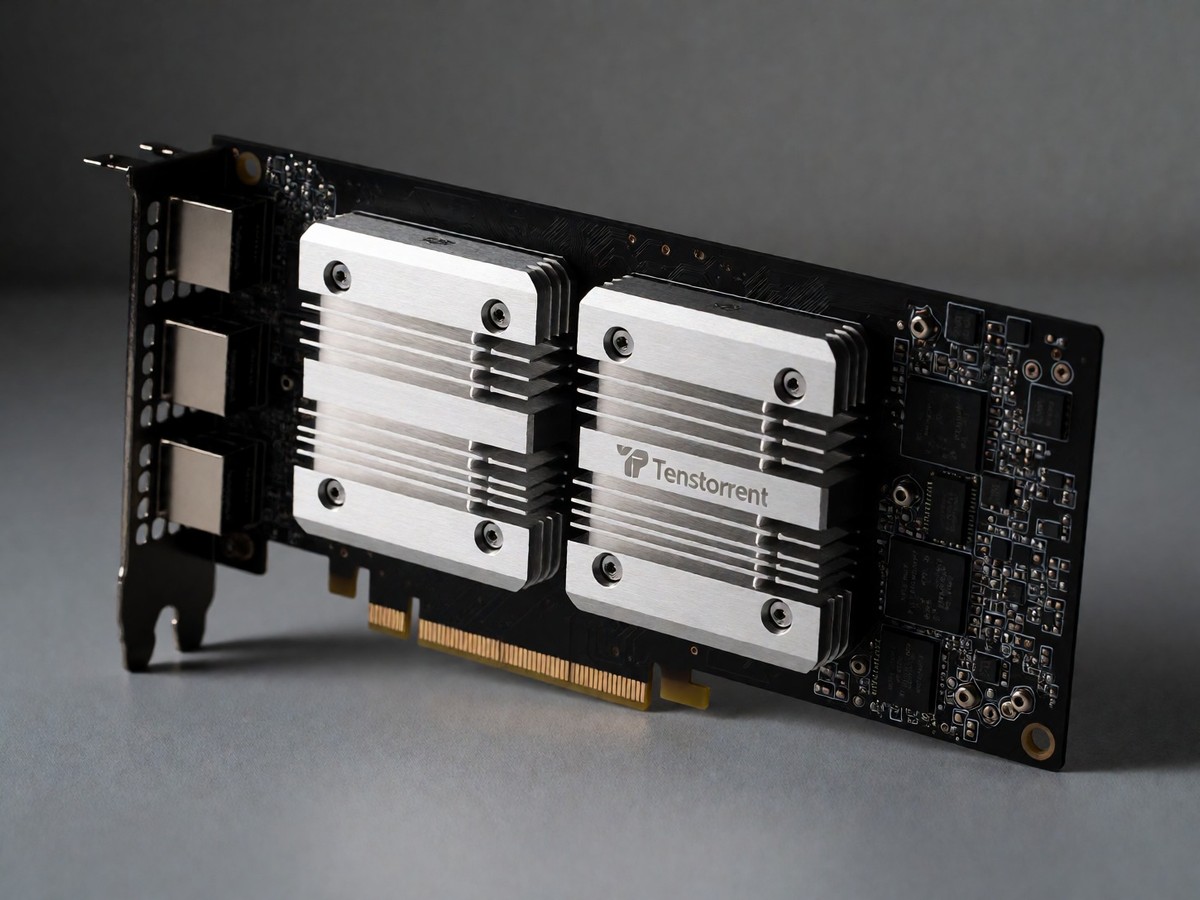
Tenstorrent sells the Wormhole n150 and n300 PCIe cards for AI development. These cards replace the first generation Grayskull boards. The n150 contains a single processor, while the n300 holds a pair of processors on one card. The TT-LoudBox workstation contains four n300 cards for a total of eight processors and includes two Intel Xeon 4309Y 8-core processors, 512GB RAM, 4TB NVME storage, and twin 10 GbE copper ethernet. The TT-QuietBox provides a liquid-cooled version of the same hardware for $15,000 and includes a single AMD EPYC 8124P 16-core CPU. I find the choice between the $12,000 LoudBox and the liquid-cooled QuietBox useful for different thermal needs. The n150 and n300 are 3/4 size PCIe add-in cards designed for developers interested in scalability for multi-chip development.
| Spec | Wormhole n300 |
|---|---|
| Tensix cores | 128 |
| GDDR6 memory | 24 GB |
| On-chip SRAM | 192 MB |
| FP8 performance | 466 TFLOPS |
| FP16 performance | 131 TFLOPS |
| Board power | 300 W |
The n300 uses PCIe 4.0 x16 and requires 300W of board power. The n300 links two processors on the board at 200G. Each chip holds 12 GB of memory. The n300 has 24 GB of total GDDR6 memory. This card provides 466 TFLOPS of FP8 performance and 131 TFLOPS of FP16 performance. The n300 includes two QSFP-DD 200G ports plus Warp 100 bridge connectors.
Software stacks and scaling capacity
Developers use the open-source TT-Buda, TT-Metallium, TT-NN, and TT-Forge software stacks to run models on these cards. These stacks support multiple large language models and other popular AI models. The Wormhole processors use Tensix cores containing five "baby RISC-V" microprocessors. These cores scale across multiple chips without virtualization. You should confirm your specific model has a working multi-chip version in the Tenstorrent model library before you purchase a card.
The Tensix cores provide hardware and software support to scale across multiple Wormhole chips. This native scalability helps developers work on multi-chip AI software without needing specialized switches. The n300 holds a 7-8B parameter model on one chip or a 13-14B parameter model across both chips. A 30-34B parameter model at 4-bit precision requires both chips to function. A 70B parameter model does not fit on the n300. I find the scaling approach useful for developers moving between single-chip and multi-chip setups. The Tensix core includes a compute unit, network-on-chip, local cache, and "baby RISC-V" cores that assist data movement through the chip. These cores allow the chips to act as one single massive network of Tensix cores to software.
Cooling and power requirements
The n300 is a passive server version that requires strong airflow in a desktop tower. If you lack sufficient airflow, the card slows itself down to stay within safe temperatures. Tenstorrent sells an Active Cooling Kit for those using desktop towers without strong airflow. The n300 requires an EPS12V power connector rather than a standard PCIe 6+2-pin cable. I find the necessity of writing a lot of shitty code to connect the tt-inference-server, tt-metal, and tt-vllm locally to be a frustrating reality. The n300 is for developers who are comfortable working outside CUDA and have a server with strong airflow.
The memory on the n300 is split between two chips, which shapes what fits. One chip holds enough for a 7-8B model at 4-bit or 8-bit. The 13-14B parameter models fit on both chips. I find the memory constraints on the n300 difficult when running larger models. Does the software maturity stay behind CUDA?