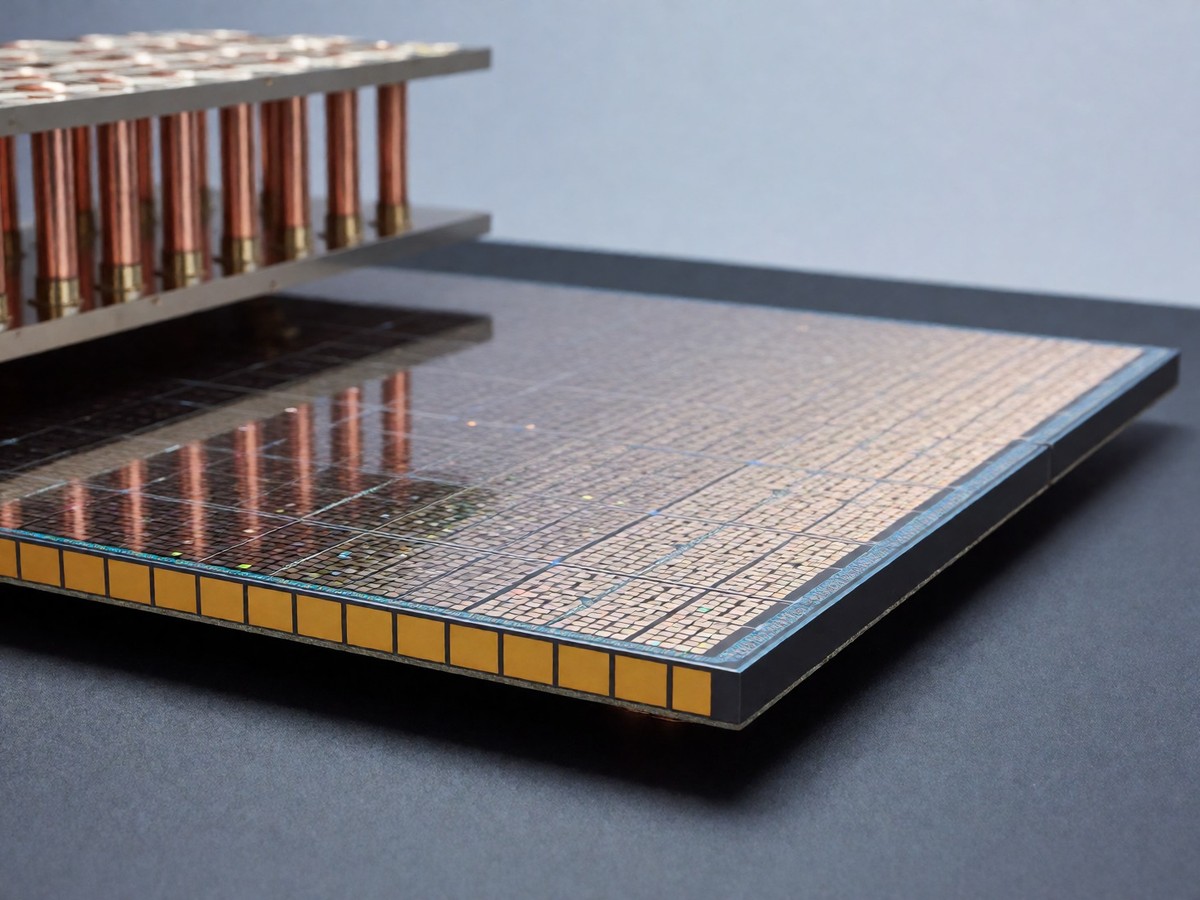
The Cerebras WSE-2 occupies 46,225 mm2 of silicon, a size 56 times larger than the 221 million transistor Intel McKinley processor from 2002. This single chip contains 2.6 trillion transistors and 850,000 cores arranged in a 2-D mesh topology. This compares to the largest GPU, which includes 21.1 billion transistors and requires 815 mm2 of die space. The WSE-2 architecture integrates 850,000 cores within a 46,225 mm2 silicon area to provide 20 PB/s of memory bandwidth and 220 Pb/s of fabric bandwidth for demanding and intensive modern AI workloads. The system runs at 1.10 GHz and uses TSMC 7 nm process technology. Cerebras uses a "cold plate" attached above the silicon with multiple vertically mounted water pipes to cool the chip directly. The Sparse Linear Algebra Compute cores eliminate multiply-by-zeros operations. The 40 GB of on-chip memory is uniformly distributed among these cores, which enables fast local access to model parameters. This capacity far exceeds the 256 MB L3 cache found in an AMD EPYC 7702P. Because no manufacturer produces perfect wafers, Cerebras designs redundant processing cores to route around defects. This approach avoids the need to wire together hundreds of discrete chips, but the massive size makes the hardware impossible to fit in a traditional package. The WSE-2 architecture clearly solves the interconnect bottleneck by keeping everything on a single piece of silicon. I find the physical scale of 46,225 mm2 as large as a computer keyboard difficult to process in a data center context.
Feldman’s high stakes
Andrew Feldman, who co-founded SeaMicro before AMD acquired it for $357 million, leads Cerebras. He and his team proposed building a chip 56 times larger than previous designs, a move many dismissed as madness. The company raised $1 billion in a round announced September 30, backed by Fidelity Management & Research Company, Tiger Global Management, and 1789 Capital. This brings the company valuation to $8 billion. Feldman withdrew the IPO paperwork to update the prospectus after regulators scrutinized the company’s relationship with G42. G42, an Abu Dhabi-backed group, bought 1% of Cerebras for $40 million in 2021 and has $1.43 billion in long-term purchase commitments. G42 accounted for 87% of revenue in the first half of 2024. This high concentration of revenue from a single customer poses a material risk. You might think a single customer would be a problem for any hardware provider, but Feldman relies on these large commitments to scale. In February, Cerebras was valued at $23 billion, but by May, it was asking for a valuation of up to $48.8 billion. The company also planned to sell shares at $150 to $160 each to attract buyers. The current valuation also reflects expectations for growth as the company builds out its cloud platform. Feldman previously held leadership roles at Force10 Networks and Riverstone Networks. He also raised $250 million in 2021 from Alpha Wave Ventures, the Abu Dhabi Growth Fund, and G42.
Breaking the memory wall
The CS-3 system uses the WSE-3, which packs 900,000 AI-optimized cores and 44 GB of on-chip SRAM to provide 21 PB/s of memory bandwidth. A 32-node CS-3 inference cluster contains 20 cabinets, including sixteen WSE cabinets and four NET cabinets. This cluster holds 1.408 TB of on-chip SRAM and no DRAM. Each engine in the cluster delivers 125 petaFLOPS of sparse performance. This performance level helps accommodate models like GPT-3, which contains 20B parameters, 44 layers, and 6144 hidden units. The architecture addresses the memory wall, where performance stays limited by the speed of moving model parameters from memory to cores. Traditional GPUs use off-chip High-Bandwidth Memory, which creates latency because of the physical distance between the GPU die and the HBM stacks. To scale for larger models, Cerebras uses weight streaming, where model weights are stored in external memory and streamed onto the WSE via MemoryX and SwarmX. This architecture is approximately 15x faster than leading GPU systems. OpenAI signed a multi-year agreement to deploy 750 megawatts of Cerebras systems from 2026 through 2028. Amazon Web Services also signed a deal to put Cerebras chips inside its data centers. The CS-2 system provides 7.5 PFLOPS of peak performance, which exceeds the 2.04 TFLOPS of the AMD EPYC 7702P. Will the demand for massive compute stay high enough to sustain such expensive, custom hardware?