Managing the $500 billion investment
President Donald Trump, Sam Altman, Larry Ellison, and Masayoshi Son announced the Stargate joint venture to invest $500 billion in US AI infrastructure. This project, involving OpenAI, Oracle, and SoftBank, aims to build colossal data centers across the United States. SoftBank plans to deploy $100 billion immediately, targeting $500 billion within four years. Elon Musk, a prominent Trump ally, claims SoftBank has secured less than $10 billion. Altman praised the administration, saying the president would be incredible for the country. This tension persists as Musk’s xAI competes with OpenAI. Trump claims his administration secured nearly $3 trillion in new investments, which could reach $7 trillion. The project aims to create 100,000 American jobs almost immediately through the construction of physical and virtual infrastructure to power next-generation AI advancements.
Scaling the data center sites
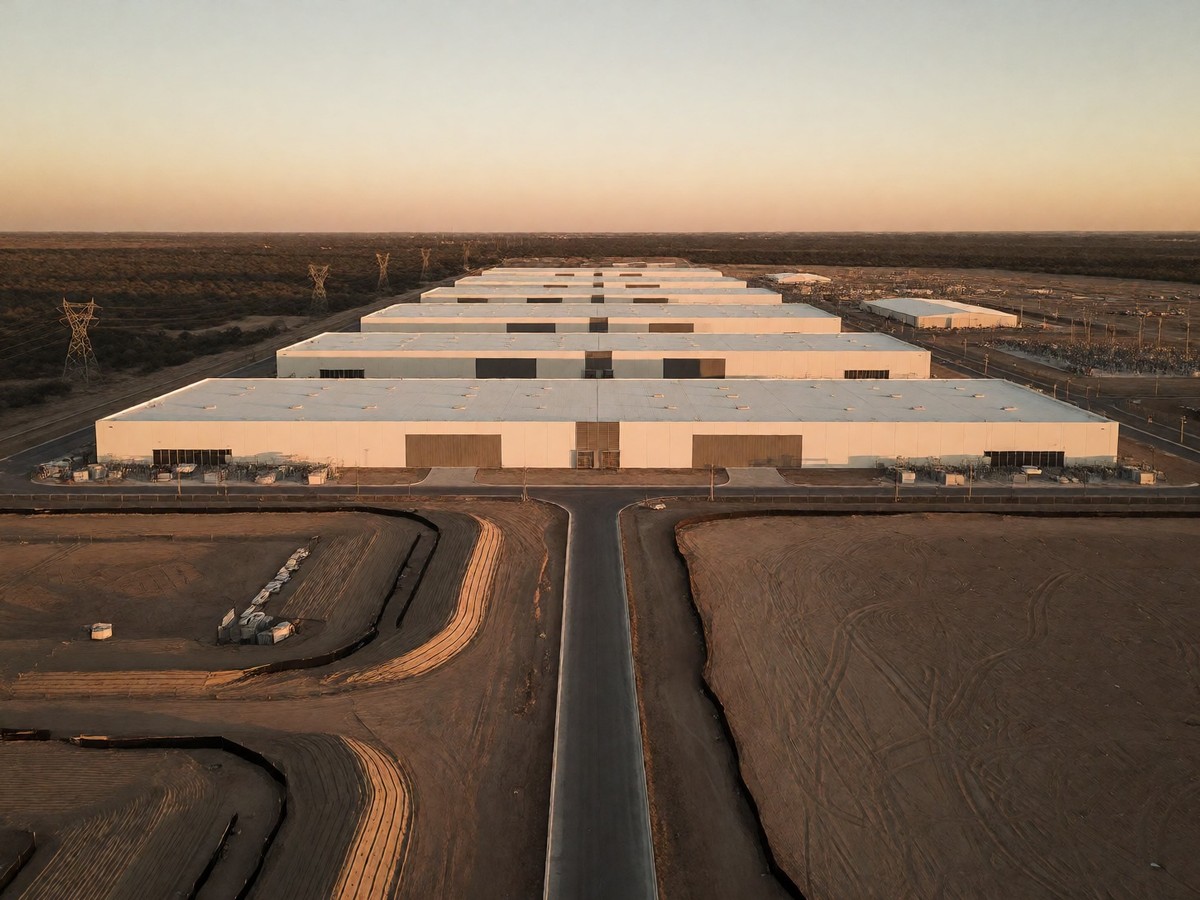
The project functions as a collection of individual sites with various developers and financing structures. In Taylor County, Texas, the Abilene campus targets 1.2 GW of power across eight buildings. The facility comprises eight buildings totaling 4 million square feet. Phase 1, delivering 200 MW of IT capacity, became operational in September 2025. Each building houses 50,000 Nvidia Blackwell GPUs using a zero-water-evaporation liquid cooling system that uses 12,625 gallons of water annually. OpenAI declined to expand the Abilene cluster to avoid mixing Blackwell chips with the upcoming Vera Rubin architecture. This decision left 700 MW of capacity for Microsoft to lease. Nvidia paid a $150 million deposit to Crusoe to secure the expansion capacity. The City of Abilene and Taylor County granted the project an 85% property tax abatement.
In Shackelford County, the Vantage Frontier project targets 1.4 GW of IT capacity across 10 buildings. The project spans 1,200 acres and includes 3.7 million square feet of space. The $25 billion project uses 210 Jenbacher engines for 700 MW of capacity. This allows the site to operate off the ERCOT grid. Shackelford County Commissioners approved a 10-year tax abatement, which includes $10 million in annual payments in lieu of property taxes. In Milam County, SoftBank and OpenAI broke ground in October 2025 on a 1.2 GW site. SoftBank and OpenAI invested $500 million each in SB Energy, which has $1.8 billion in total capital. The site uses modular units from a former Foxconn plant in Lordstown, Ohio. The site also sits near the Orion Solar Belt, which has 900 MWdc of solar capacity.
| Site Name | Location | IT Capacity | Primary Developer |
|---|---|---|---|
| Abilene | Taylor County, TX | 1.2 GW | Crusoe |
| Frontier | Shackelford County, TX | 1.4 GW | Vantage |
| Milam County | Milam County, TX | 1.2 GW | SB Energy |
| Lighthouse | Port Washington, WI | 902 MW | Vantage |
The decision to walk away from the Abilene expansion with Oracle reveals the instability of these partnerships.
Powering the AI load
The power requirements for these facilities strain the PJM Interconnection grid, which serves 67 million customers in 13 states. PJM expects 32 gigawatts of increased demand by 2030, mostly from data centers. The recent PJM auction fell 6.8 gigawatts short of what the grid needs to guarantee system reliability during demand spikes, a shortfall equivalent to almost seven traditional nuclear reactors that would usually provide power to millions of homes. Data centers contributed $6.3 billion to the $16.4 billion auction total. PJM power prices jumped 76% during the first quarter because of AI demand. You should watch how companies like Vantage bypass the grid by using onsite gas turbines. In West Virginia, Senator Glenn Jeffries says the state can provide coal, natural gas, and renewables for such projects. Kevin O’Leary noted that locations like West Virginia and North Dakota provide massive amounts of stranded gas. The pressure on the grid increases as data centers draw peak power to prevent hardware from overheating. The PJM region includes states from Illinois to Tennessee, Virginia to New Jersey. Will the shift toward onsite gas turbines resolve the grid reliability crisis permanently?