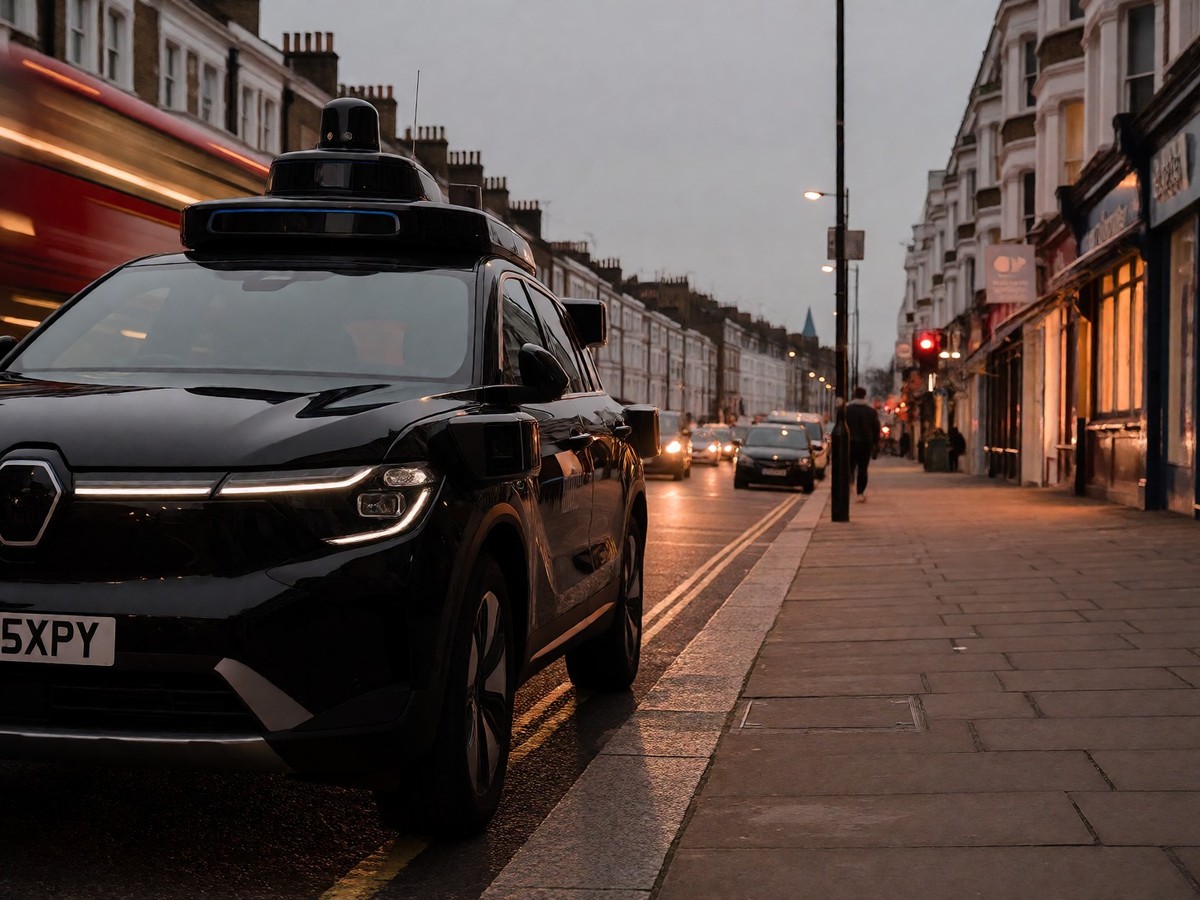
Wayve reached an $8.6 billion valuation following its Series D funding round in February 2026. The company completed an $85 million employee tender offer in June 2026. Wayve is a UK-based autonomous driving startup, founded in 2017, that develops embodied AI software to manage point-to-point navigation across different environments and vehicle platforms. The technology functions without relying on high-definition maps or specific sensors. Wayve builds end-to-end driving software that handles everything from L2+ assistance to L4 eyes-off automation. The company employs about 1,200 people across six countries.
The February 2026 funding round included $1.2 billion from Eclipse Ventures, Balderton Capital, SoftBank Vision Fund 2, and Nissan. New participants in the round included Ontario Teachers’ Pension Plan, Baillie Gifford, British Business Bank, and Icehouse Ventures. Strategic backers provided support, including Microsoft, NVIDIA, Uber, and Mercedes-Benz. Wayve also received $60 million in April 2026 from Advanced Micro Devices, Arm, Qualcomm Ventures, and other semiconductor companies. This follows a $1.05 billion Series C in May 2024 and a $200 million Series B in January 2022. Earlier funding included $13.7 million from Ocado Group in 2021 and $20 million in 2019.
The company uses a suite of technologies including fleet learning, data infrastructure, evaluation, and simulation platforms. These tools improve AI models by combining real-world and simulated data. Wayve’s foundation models enable vehicles to perceive and navigate any environment. The software allows original equipment manufacturers to upgrade cars to higher autonomy levels through software updates. Wayve’s end-to-end machine learning approach allows the system to learn to drive from data rather than from hand-coded rules, which facilitates adaptation to new cities and different driving conditions without constant human intervention.
Scaling robotaxis with Uber and Stellantis
Wayve entered a partnership with Uber and Stellantis to develop and deploy Level 4 driverless robotaxis globally. This collaboration builds on a recent L2++ agreement between Stellantis and Wayve and a partnership between Wayve and Uber to deploy autonomous rides in London, Tokyo, and other global markets. Uber plans to deploy these autonomous vehicles on its global mobility network. Wayve provides the AI driving software, while automakers provide L4-capable vehicles. This collaboration targets deployment in cities across Europe and North America.
The partnership combines Stellantis’ L4-Ready Platforms with Wayve’s adaptive AI and Uber’s marketplace. Stellantis designs and manufactures vehicles with embedded sensor suites for high-utilization driverless operations. Wayve’s technology enables vehicles to understand and navigate complex real-world environments. The companies work together on vehicle integration, testing, validation, and deployment.
Stellantis handles vehicle integration and manufacturing, while Wayve provides the AI technology and Uber manages the mobility platform and fleet operations. These companies work together on vehicle integration and deployment. They aim to bring reliable autonomous mobility to millions of riders. You already know that scaling requires massive data, so look at how Wayve integrates these components. The partnership between Stellatis, Wayve, and Uber is a non-binding Memorandum of Understanding.
Data through GAIA-2 simulation
Wayve’s GAIA-2 model is a video-generative world model for autonomous driving. This system uses a video tokenizer and a latent diffusion world model to generate high-fidelity simulations. GAIA-2 produces high-resolution, spatiotemporally consistent multi-camera videos across different geographic regions like the UK, US, and Germany. The model generates scenarios based on ego-vehicle kinematics, agent behavior, and road semantics. The architecture uses a space-time factorized transformer with an asymmetric encoder-decoder structure that includes 85 million and 200 million parameters.
GAIA-2 expands test coverage by synthesizing common driving conditions and elusive corner cases. These include unpredictable agents, extreme weather, unusual traffic patterns, or unexpected environmental changes. This capability reduces the need for expensive real-world data collection. Developers use these simulations to probe model weaknesses and refine performance. The model uses a 32×32 spatial compression rate and an increased channel dimension in its latent space. This setup allows for shorter latent sequences and better memory efficiency. The video tokenizer compresses raw pixel-space videos into a compact, semantically meaningful latent space.
| Feature | GAIA-2 Specification |
|---|---|
| Model Type | Latent diffusion world model |
| Camera Streams | Up to five consistent streams |
| Resolution | 448 x 960 |
| Components | Video tokenizer and latent world model |
The ability to generate diverse scenarios improves safety and reliability. GAIA-2 supports conditioning from external models, including CLIP embeddings and a proprietary driving model. Does the use of synthetic data eventually replace the need for physical road testing?