Physical Intelligence secured $400 million in Series A funding to develop a generalist robotic brain capable of controlling diverse platforms. This investment, led by Jeff Bezos, Thrive Capital, and Lux Capital, aims to move robotics away from the single-task paradigm. While traditional automation requires unique programming for every movement, the $\pi_0$ model uses a vision-language-action architecture to perform various tasks across different hardware. This capability allows a single software system to manage everything from industrial arms to humanoid robots.
The industry is shifting from digital AI to Physical AI, where machines interact with the real world. In 2026, the capital flowing into this sector exceeds $12 billion. This movement addresses a systemic failure in labor availability. Manufacturing faces 415,000 unfilled jobs, and 76% of logistics operations report labor shortages. Companies buy robotics because they need to keep production lines running despite these shortages. They are not chasing innovation for its own sake. They are looking for a way to replace unavailable human labor with reliable, programmable systems.
How $\pi_0$ controls diverse hardware
The $\pi_0$ foundation model relies on a 3-billion parameter vision-language model called PaliGemma. Physical Intelligence augments this with a 300-million parameter action expert module. This hybrid setup allows the robot to understand visual scenes and natural language instructions while generating motor commands. The model uses a technique called flow matching to produce smooth, continuous trajectories at a frequency of 50Hz. Because the model generates an entire 50-step action chunk at once, it can execute up to 50 actions before it needs to run inference again, though it executes them open-loop to avoid issues with temporal ensembling.
To achieve this level of movement, the system processes images and language prompts alongside the robot’s proprioceptive state. The action expert handles the inputs that the original vision-language model does not see during its pre-training. During testing, the model demonstrated ability in tasks like folding laundry, bagging groceries, and bussing tables. In a bussing task, the robot follows instructions to pick up specific objects and place them in correct receptacles. In grocery bagging trials, the model successfully put seven specific items into a paper bag. The model also showed emergent behaviors, such as shaking a plate to clear crumbs before stacking it.
The cross-embodiment capability remains the main technical advantage. By training on 10,000 hours of data from seven different robot types, the model controls hardware it has never encountered before. This decoupling of intelligence from the mechanical body means a facility can download the same brain into different machines. A robot can learn to handle a new object in hours rather than weeks of manual programming. This efficiency changes how warehouses approach task deployment.
Managing the labor gap in logistics
The math for deploying humanoids depends on a comparison between human wages and robot operational costs. A fully loaded human worker in US manufacturing costs approximately $45 per hour when including benefits, taxes, and insurance. This results in an annual cost of roughly $93,600 for a single worker. In contrast, a mid-range humanoid like the Booster K1 costs $50,000 to purchase. When you add $50,000 for integration and $10,000 for annual maintenance, the first-year cost is $110,000.
The break-even point for a robot depends on the task and the number of shifts. A humanoid running two shifts per day can replace two human workers. In this scenario, the year-two cost of $11,500 per year is significantly lower than the $187,000 cost for two humans. A humanoid typically breaks even with a single human worker after 14 to 30 months of operation, depending on whether the robot achieves 40% or 70% of human throughput. The economic advantage increases in environments that require night shifts or hazardous work.
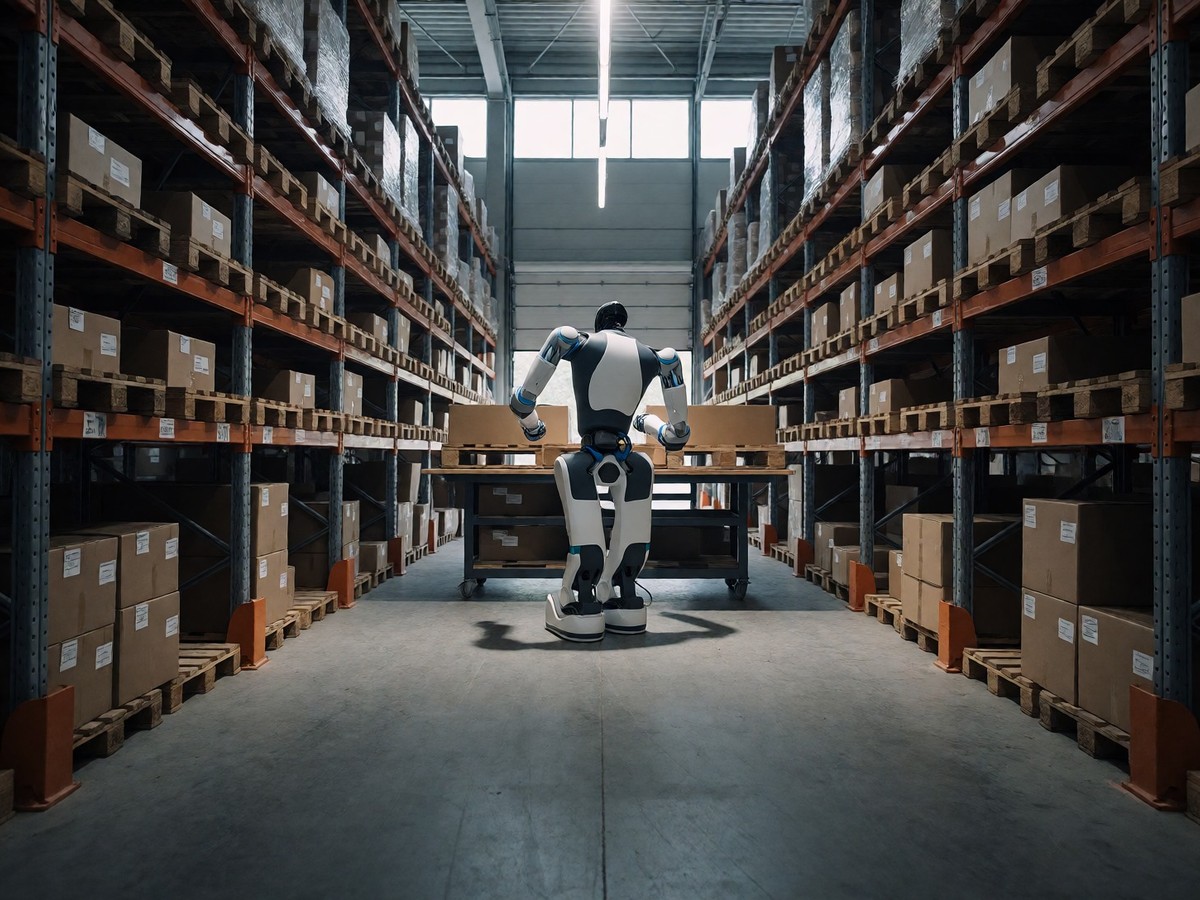
Labor shortages in logistics are particularly acute. Many companies replace entire workforces more than once per year because of turnover. In fast-food settings, for example, labor turnover exceeds 144% annually. In warehouse environments, robots like the Agility Digit have already moved over 100,000 totes in live commercial work. The goal is to use robots for repetitive, injury-prone motions that cause high turnover among human staff.
Selecting hardware and navigating price gaps
The market for humanoids in 2026 is split between low-cost research platforms and high-cost enterprise machines. You should treat every industrial humanoid price currently in circulation as vendor-guided rather than published. Most companies selling to factories use private negotiations rather than list prices. Research and development platforms from companies like Unitree have public pricing, but enterprise machines from Figure AI or Agility Robotics do not.
| Model | Category | Published Price (Approx.) | Notes |
|---|---|---|---|
| Noetix Bumi | Compact | ¥9,998 ($1,400) | China-based model |
| Unitree R1 | Research | $4,290 | Excludes tax/shipping |
| Unitree G1 | Developer | $13,500 | Base model excludes secondary development |
| 1X NEO | Consumer/Home | $20,000 | $499/month subscription available |
| Unitree H2 | Full-size | $29,900 | Higher list price than G1 |
| Kepler K2 | Mid-band | CNY 248,000 (~$34,800) | Mid-range market |
| EngineAI T800 | Mid-band | $40,500 | International pricing |
| Unitree H2 Plus | Flagship | $100,000 | Highest published list price |
| Figure 03 | Enterprise | Not disclosed | Sold via private agreements |
| Agility Digit | Enterprise | ~$250,000 (estimate) | Primarily RaaS agreements |
If you have a limited budget, you can start with hardware under $25,000. However, commercial work requires enough budget for tooling, integration, training, and downtime. For enterprise-grade deployment, the lack of public pricing for machines like the Figure 03 or Agility Digit makes budgeting an exercise in guesswork. You must ask vendors for a landed, task-ready quote that includes shipping, customs, and destination support.
Transitioning from ownership to outcomes
The business model for robotics has shifted toward Robots-as-a-Service (RaaS). This model removes the two biggest barriers to adoption: upfront capital and technical risk. Instead of buying a machine, companies buy an outcome. A contract might commit to moving a specific number of totes per hour with a certain level of reliability. This is similar to a software subscription where the vendor manages deployment and uptime.
Companies like Formic use a full-service automation model. They own the entire lifecycle, including engineering, deployment, and continuous improvement. This approach helps factories that lack the expertise to manage and service robots themselves. Agility Robotics also uses RaaS to manage the risk of deploying its Digit platform in warehouse environments.
This shift changes how companies evaluate ROI. You are no longer calculating the depreciation of a piece of hardware. You are evaluating the monthly cost of a completed task. This makes robotics more like infrastructure than equipment. The vendor becomes responsible for the machine’s performance, which aligns their interests with the customer’s productivity goals.
The data flywheel and deployment hurdles
A major barrier to deployment is the effort required to teach a robot a new task. Current imitation learning methods require 50 to 200 teleoperated demonstrations per task. For a facility with 20 tasks, this could mean 1,000 to 4,000 demonstrations. This requirement creates a data collection bottleneck that can take weeks to overcome.
Successful robot companies build a data flywheel. More deployed robots lead to more real-world data, which leads to better training and better performance. This advantage compounds over time. As a fleet collects more data from chaotic, real-world environments, the AI improves, allowing the company to automate adjacent tasks and build a reputation for reliability.
Deployment is not just about the robot’s movement. You must budget for end-effectors, fixtures, network connections, and safety controls. You also need to account for the time workers spend supervising the system or resetting it when it fails. A robot that requires constant human assistance will simply shift labor rather than remove it.
Navigating physical AI safety risks
The move toward Robot Foundation Models (RFMs) introduces new safety concerns. Unlike digital AI, which can only cause harm through cyberspace, Physical AI has direct causal access to the physical world. This creates risks such as accidental physical harm, privacy violations from mobile sensors, and the potential for malicious use. If an RFM is misaligned with human preferences, it could execute harmful actions in a warehouse or home.
Current research shows that many RFMs have success rates around 80% to 90% in controlled settings. This means the robot could fail to complete a task 10% to 20% of the time. In a warehouse, a failure could mean destroying a fragile object or colliding with a human worker. This high failure rate makes robust autonomous failure recovery a necessity for production.
The Physical AI Safety Institute is working to develop ways to interpret, align, and control these models. They argue that safety research is neglected compared to the massive investment in AI capabilities. For a company to deploy robots safely, it must ensure the models are robust in unusual or unevaluated scenarios. Safety is a requirement for enterprise adoption, not just an afterthought.
Building a three-year deployment model
Enterprises should treat 2026 as a year for structured pilots rather than large-scale purchases. You should qualify vendors and negotiate pricing directly before committing heavy capital. A successful pilot requires a long enough timeframe to capture variations, failures, and maintenance needs.
To build a business case, use a three-year Total Cost of Ownership (TCO) model. Start with the acquisition or subscription cost and add landed costs, integration, training, and ongoing support. You must also subtract the resale value of the hardware. Include a downside case in your model that assumes slower throughput and more frequent interventions than the vendor promises.
A successful deployment requires treating data as a strategic asset. The manufacturers moving fastest are the ones that treat robotics as a platform and build ecosystem relationships early. Will the massive capital flowing into foundation models eventually commoditize the physical robot hardware itself? This remains a fundamental question as the industry moves toward full autonomy.