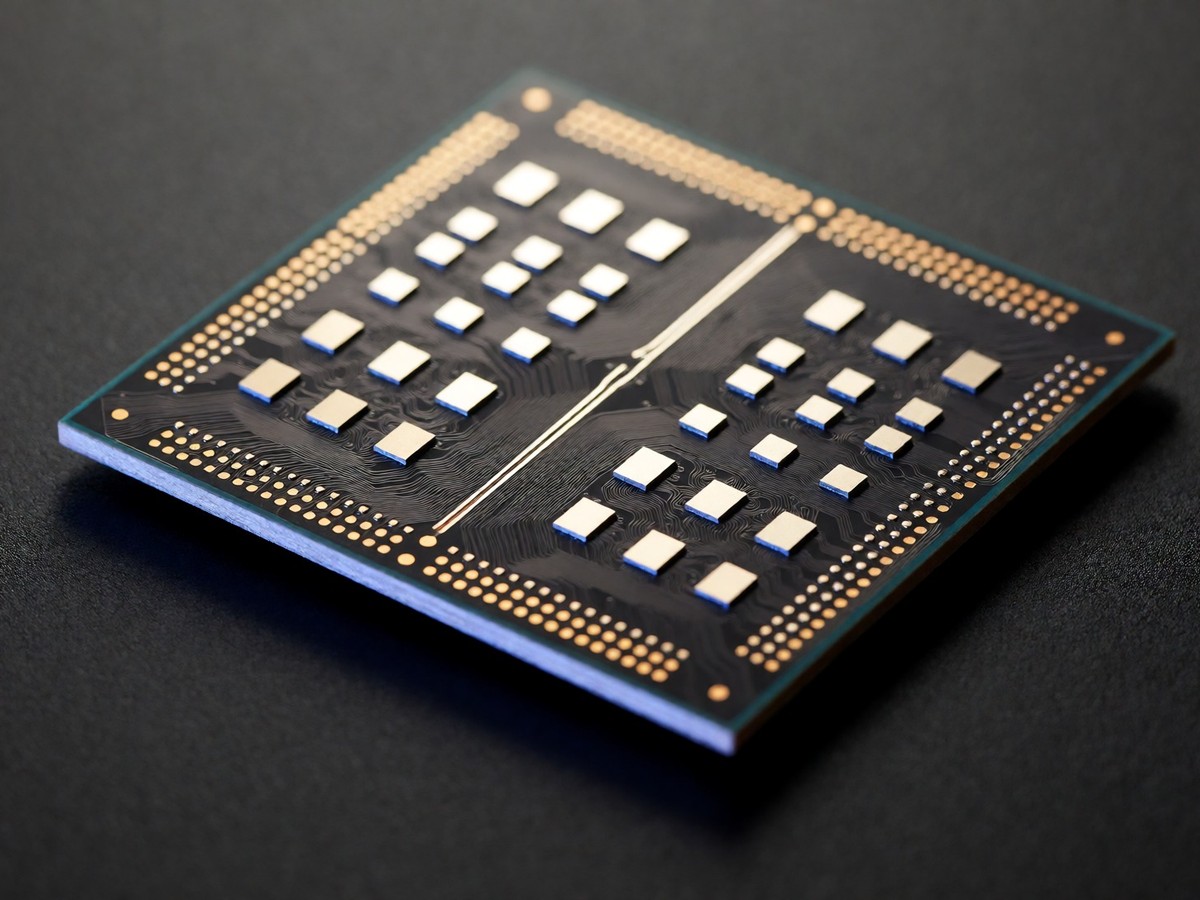
I view d-Matrix’s move into volume production as a departure from typical challenger chip announcements. The company began shipping Corsair hardware in June 2026 to hyperscalers, neoclouds, and frontier AI labs. Sid Sheth, who grew Inphi’s networking business into a $1B+ segment, leads the Santa Clara startup. He directs the company to solve the memory wall using digital in-memory compute. This architecture places computation directly within memory blocks to avoid moving data between processors and memory. The Corsair PCIe card uses TSMC 6nm process technology and Alchip Technologies for manufacturing. The Corsair PCIe card carries 6,400 mm2 of silicon with 4 GB of performance memory providing 300 TB/s of bandwidth while supporting up to 512 GB of capacity memory per card for all users. The hardware includes a RISC-V based dispatch engine within each chiplet and uses 3D DRAM stacking to keep local memory close to the logic die. Sheth, a Purdue University graduate, previously led the 100G product portfolio at NetLogic Microsystems and held engineering positions at Intel in the Pentium and network processor groups. He also founded Aeluros, a mixed-signal networking IC company, and brings decades of experience managing businesses that reached over $1B in revenue. D-Matrix has raised $429M total, including a $275M Series C round in late 2025 that valued the company at $2 billion. The company now employs more than 300 people.
Performance against NVIDIA systems
The Corsair platform delivers 10x faster inference and 5x better energy efficiency when paired with NVIDIA Blackwell. You already know that data movement slows down inference. Corsair handles the decode phase of inference while the GPU manages the prefill phase. This hybrid configuration allows data center operators to add throughput without replacing existing GPU infrastructure. I find the technical performance impressive, but the whitepaper reveals a performance cliff. In performance mode, the chip utilizes 2GB of on-chip SRAM to hold the model. If a model exceeds this capacity, the system enters capacity mode and relies on off-chip DRAM. Since the hardware lacks HBM, performance falls heavily when the model scales beyond the SRAM.
| Feature | Corsair Specification |
|---|---|
| Silicon Area | 6,400 mm2 |
| Performance Memory | 4 GB |
| Memory Bandwidth | 300 TB/s |
| Capacity Memory | Up to 512 GB |
| MXINT8 Compute | 4,800 TFLOPs (dual-card) |
| MXINT4 Compute | 19,200 TFLOPs (dual-card) |
Gimlet Labs tested the system with a speculative-decoding workload and saw response times drop from 24 seconds to under 2 seconds when they paired Corsair with GPUs. This performance relies on MXINT8 and MXINT4 precision formats. A dual-card configuration hits 4,800 TFLOPs for MXINT8 and 19,200 TFLOPs for MXINT4. D-Matrix provides 10x more SRAM than competitors like Groq, which offers 230MB per card. The system achieves 2ms time-per-output-token for Llama3-70B by using 6MB "stash" memory per chiplet and LPDDR5X memory placed close to processing elements. The matrix multiplier performs 64×64 matmuls with INT8 or 64×128 with INT4. Using structured sparsity, the system provides 5x compression. While Qualcomm’s AI200 offers 768GB of LPDDR5X per card, Corsair relies on its two-tier memory split to manage capacity.
Scaling through Squadron and partnerships
The company expands its reach through the d-Matrix Squadron, a multi-rack compute cluster announced on October 12, 2026. This fleet offers megawatts of inference compute for large-scale workloads. D-Matrix attracts massive investment, including $429M total across four rounds. Microsoft M12 and Temasek provided funding during the $275M Series C round in November 2025. The company also uses JetStream NICs to provide scale-out capabilities between Corsair nodes. I see the company targeting data centers that cannot support liquid cooling, as the PCIe cards run with air cooling. D-Matrix works with Supermicro to build these air-cooled Corsair servers and racks.
During the OCP Global Summit, Sid Sheth demonstrated how pairing an NVIDIA H100 with eight Corsair XPUs generates 845 tokens per second per user. This setup achieved over 20,000 tokens per second across 64 concurrent users. This feat relies on offloading feed-forward network computation to the SRAM-based architecture. The interconnect maintains a 115ns D2D latency for a 16 chiplet all-to-all connection, and the JetStream NIC provides 2us of latency for scale-out fabrics. Fast Company named the Corsair platform Foundational AI Technology on its 2026 Next Big Things in Tech list. D-Matrix targets the APAC and US enterprise data center markets. D-Matrix currently targets a $5 billion valuation as it seeks additional financing. Will the lack of HBM prevent d-Matrix from dominating the largest LLM deployments?