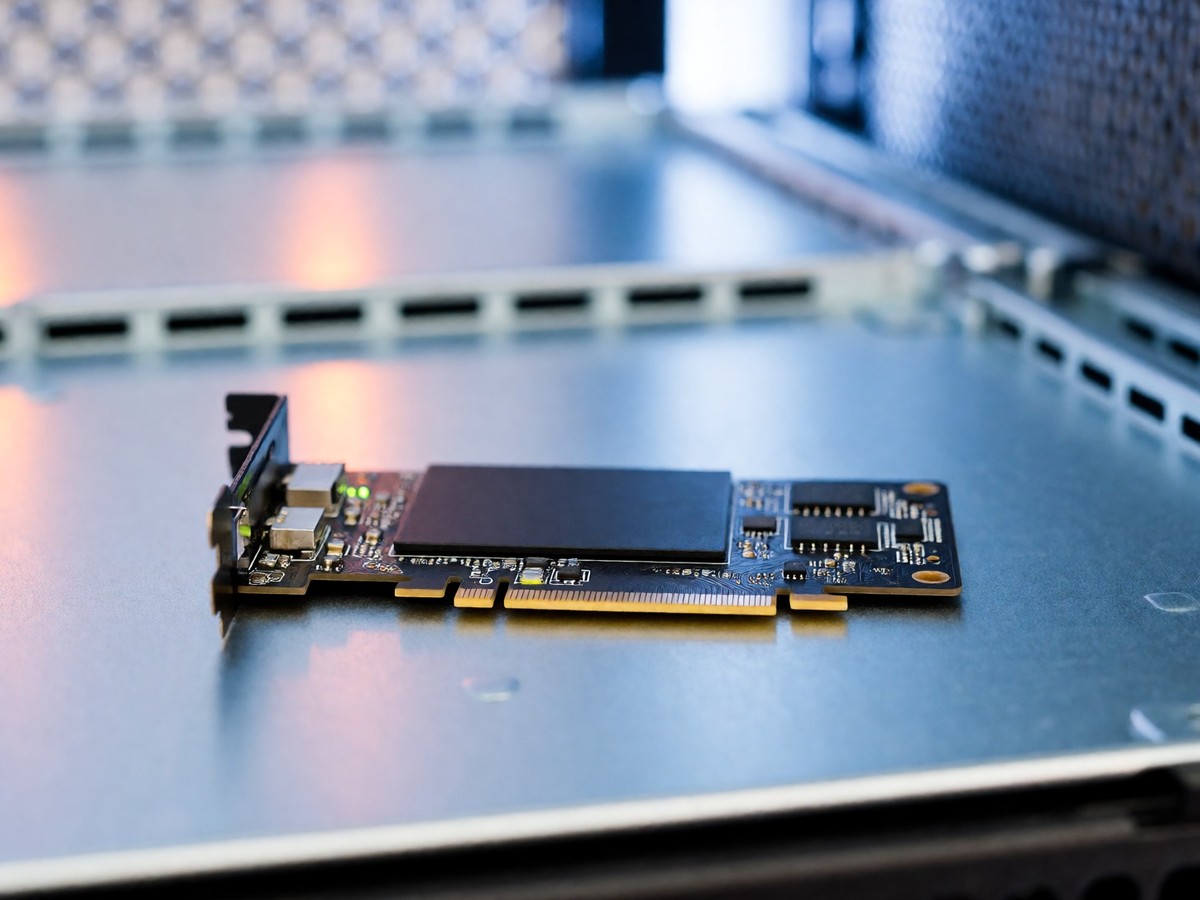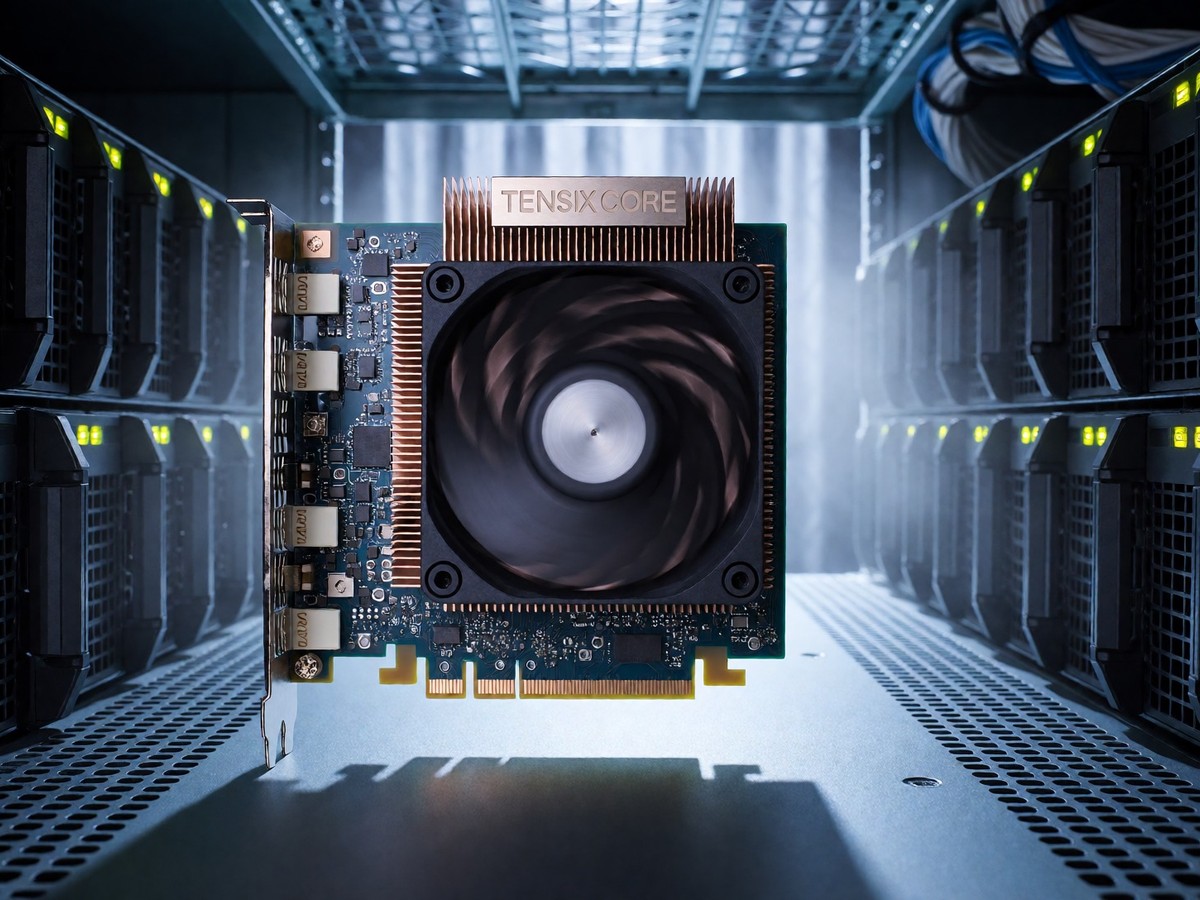
The Tenstorrent Galaxy Blackhole system provides 23 PFLOPS of Block FP8 compute using 32 Blackhole chips for $110,000. This rack-scale hardware includes 6.2 GB of on-chip SRAM at 2.9 PB/s and 1 TB of DRAM with 16 TB/s aggregate bandwidth. I find the architectural shift toward explicit data movement over hardware cache hierarchies effective for predictable performance. The Blackhole p150 developer card includes 32 GB of GDDR6 and sells for $1,399. This card draws up to 300W in its active-cooled workstation form factor. Tenstorrent engineers designed the Blackhole chip with 16 big RISC-V cores to manage data movement on-die, which eliminates the host CPU overhead that bottlenecked the previous Wormhole n300 architecture during small-batch workloads. While NVIDIA H200 SXM uses 141 GB of HBM3e with 4.8 TB/s bandwidth, it costs roughly $2.60 per GPU-hour. Tenstorrent uses GDDR6 to keep hardware prices lower.
The Tensix core functions as a self-contained compute tile. It includes a RISC-V data movement processor, a matrix engine with an 8×8 BF16 tile multiply-accumulate unit, and a vector unit for element-wise operations. Each core has 1.5 MB of local L1 SRAM. This distributed SRAM helps mitigate the lower bandwidth of GDDR6 compared to NVIDIA’s HBM3. For example, the Wormhole n300 card provides 24 GB of GDDR6 at 576 GB/s, while the H100 provides 80 GB of HBM3 at 3.35 TB/s. Tenstorrent engineers rely on the programmer to schedule data movement from DRAM to SRAM. The p100a version remains an economical entry point with 28 GB of GDDR6 for $999.
Performance and the software reality
The hardware economics change when scaling to massive models like DeepSeek R1. Tenstorrent demonstrated 350+ tokens per second per user on DeepSeek R1 671B using 16 Galaxy Blackhole units. This configuration uses a batch size of 32 and supports up to 128K context. I calculate a cost of $6 per million tokens for this setup, while NVIDIA users pay an implied $30 per million tokens. You should consider the engineering ramp if you plan to switch from CUDA. The TT-Metal compiler stack remains in an early stage of maturity. Tenstorrent issued firmware v19.5.0 in February 2026, which reduced the Tensix core count on p150 cards from 140 to 120 and lowered SRAM from 210 MB to 180 MB. This change, a yield decision, dropped the BlockFP8 figure from 774 TFLOPS to 664 TFLOPS.
Tenstorrent’s Wormhole generation provides the most mature documentation and verified model support. The n150 single-chip PCIe card carries 72 Tensix cores and 108 MB of distributed SRAM. The n300 dual-chip board provides 128 Tensix cores and 192 MB of SRAM. While an 8x H100 SXM5 node running vLLM achieves 2,500-3,500 tokens/sec on Llama 70B at batch 32, the Wormhole Galaxy reaches 4,000-5,000 tokens/sec. The H100 vLLM numbers include routing overhead, continuous batching, and PagedAttention, whereas Galaxy numbers come from controlled single-model benchmark runs. Will the software gap close before NVIDIA launches its next architecture?
Scaling and interconnects
Scale-out capabilities rely on the integrated Ethernet fabric rather than NVLink or InfiniBand. Every Blackhole chip includes four passive QSFP-DD 800G ports for connecting to other cards. The Galaxy Blackhole system uses 56 x 800G Ethernet ports to provide 11.2 TB/s of scale-out bandwidth. Moreh’s MoAI Inference Framework combines Tenstorrent Wormhole chips with NVIDIA or AMD GPUs to improve token-per-second speed by 7-8%. This heterogeneous cluster reduces the cost per million tokens by 15-18% for MoE models like GPT-OSS, Qwen, and DeepSeek. The Wormhole Galaxy delivers 4,000-5,000 tokens/sec on Llama 70B at batch 32.
| Hardware | VRAM | Memory Bandwidth | FP8 Performance |
|---|---|---|---|
| H200 SXM | 141 GB HBM3e | 4.8 TB/s | 3,958 TFLOPS |
| H100 SXM | 80 GB HBM3 | 3.35 TB/s | 3,958 TFLOPS |
| Blackhole p150 | 32 GB GDDR6 | ~1 TB/s | 664 TFLOPS |
| Wormhole n300 | 24 GB GDDR6 | 576 GB/s | 466 TFLOPS |
Smallest.ai reports that using the Tenstorrent architecture for the Lightning V2 model achieves 4x lower on-prem accelerator cost compared to an NVIDIA L40S baseline. This results from the distributed dataflow architecture and the use of distributed SRAM. Moreh uses its MoAI Inference Framework to manage disaggregated serving, where Wormhole accelerators handle the memory-heavy pre-fill stage. This reduces the need for expensive high-bandwidth memory on GPUs. A 4-Galaxy supercluster starts at $440,000.