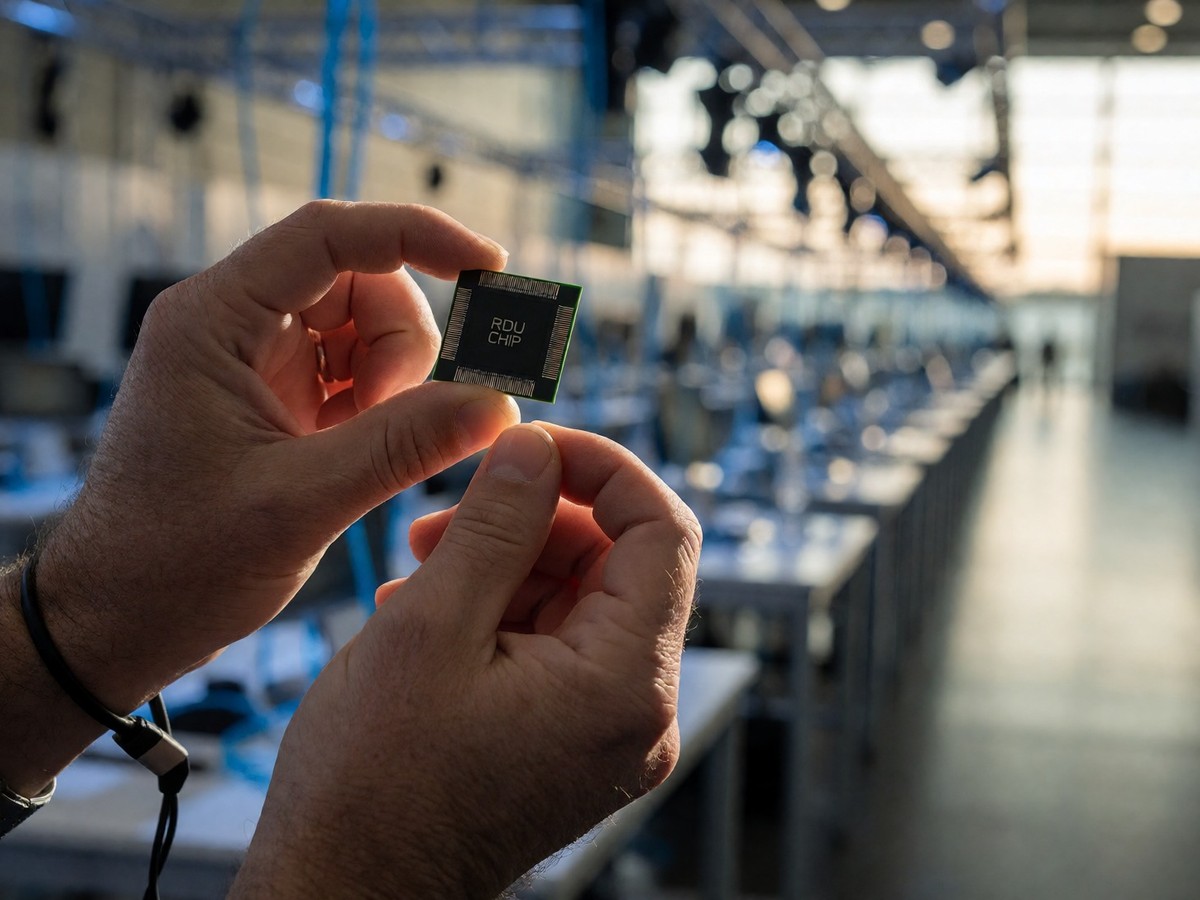
SambaNova’s SN40L employs TSMC 5 nm technology and delivers 688 FP16 Tflop/s. The company makes the chip available on the SambaNova-hosted cloud, and on-premises system shipments occur in 2024. Rodrigo Liang, the company’s CEO, claims the chip runs Llama 400B models at 115 tokens per second, a speed he says exceeds competitors by ten times while consuming less than 19 kilowatt of power. General Compute CEO Finn Puklowski expects new chips to reach 600 to 700 tokens per second, which compares to the 250 tokens per second typical for GPUs. I find the discrepancy between Liang’s 115 tokens and Puklowski’s 600+ tokens projection confusing. The Reconfigurable Dataflow Unit architecture, which originated at Stanford, eliminates the need for an on-chip ISA by compiling models from Hugging Face directly onto the hardware. This processor targets AI workloads by providing software-defined hardware that allows users to dynamically reconfigure the platform to meet the demands of diverse applications. The RDU is the core of the platform and allows for seamless scalability as organizational needs grow. SambaNova builds everything from the architecture all the way down to the substrates to compete with Nvidia.
| Spec | Value |
|---|---|
| Technology | TSMC 5 nm |
| FP16 Performance | 688 Tflop/s |
| Power Consumption | < 19 kilowatt |
| Architecture | Reconfigurable Dataflow Unit (RDU) |
| Training Focus | High (No INT8 acceleration) |
RDU architecture and training efficiency
The Reconfigurable Dataflow Unit architecture allows for dynamic maximization of computing resources. This system uses a three-tier memory architecture including on-chip SRAM, HBM, and DDR to reduce unnecessary data movement. While the SN40L handles both training and inference, it performs better during training because it lacks additional acceleration for INT8 and other inference data types. The platform uses a three-tier memory architecture with on-chip SRAM, HBM, and DDR to keep hot data close to compute and reduce the memory round trips that limit GPU-based inference performance. The Tflops/W on this chip falls short of Nvidia’s efficiency. The RDU addresses challenges in Composition of Experts (CoE) inference by using streaming dataflow parallelism and high memory capacity to keep many experts in memory. This prevents the low operational intensity that often reduces GPU utilization when running small experts. The RDU provides the performance needed for large models by keeping many experts in memory. This architecture keeps decode moving and serves more concurrent users without hitting the memory wall that limits GPU-based inference. By fusing operations into one continuous pipeline, the RDU removes the memory round trips between kernels that typically slow down execution. The RDU is a processor specifically engineered to accelerate AI workloads, delivering performance and power efficiency compared to conventional CPUs and GPUs.
Market positioning and deployment realities
SambaNova raised $1.1 billion from investors like BlackRock, Google Ventures, Softbank, and Intel Capital, reaching a $5.1 billion valuation. The company started shipping its first production systems in 2Q 2020 and maintains two more chips in production. Current customers include Lawrence Livermore Laboratory, Argonne National Laboratory, and OTP Bank. General Compute ordered $300 million worth of SN50 chips to deploy them in existing data center facilities. Because these chips use air-cooling instead of water-cooling, they do not require the new infrastructure investments that liquid-cooled systems demand, allowing companies to use existing data center facilities or repurposed crypto mining infrastructure. Puklowski wants to turn hour-long workloads for coding agents into five or ten minute tasks. He notes that ChatGPT provides 50 tokens per second, which remains faster than human reading speeds. I would skip this investment if you have a limited budget or need a mature ecosystem. The cost of these solutions remains high for small to medium enterprises, and the ecosystem lacks the maturity found in NVIDIA’s platform. The company has disclosed little about customer success three years after shipping its first products. SambaNova’s initial customers use its machines for HPC. The company provides integrated solutions that reduce the complexity of deploying AI solutions by providing tools and software that streamline integration with existing infrastructure.